


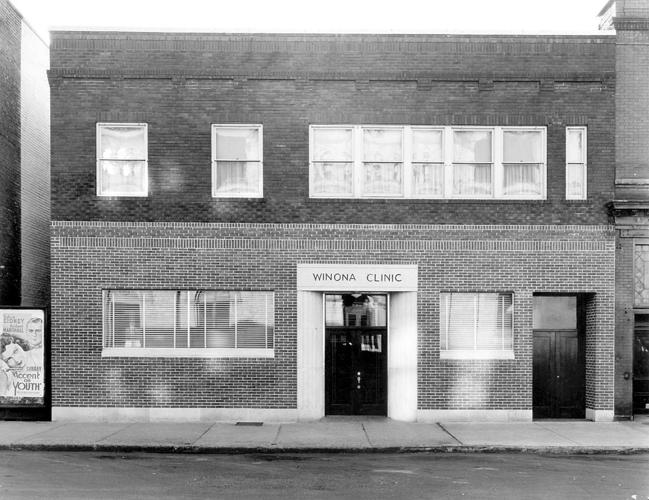
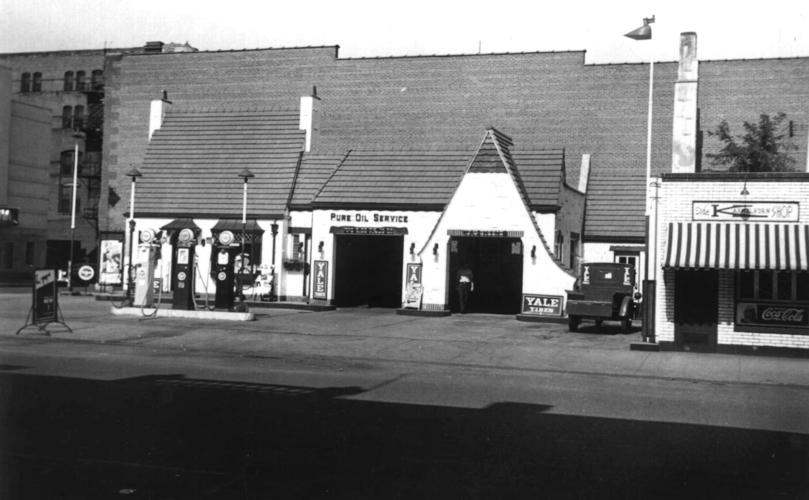
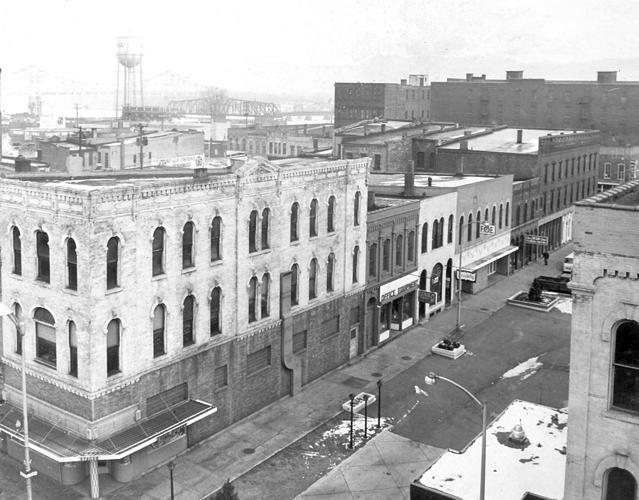

In 1957, the highway left town and took the retail district with it.
For many years, traffic on U.S. Highway 14/61 swung right at the Hot Fish Shop and slowed to a crawl down Mankato Avenue, then west onto Sarnia Street until the two roads parted company at Junction Street. Highway 61 slid northwest on Junction, toward the river, through Goodview on Sixth Street and on to Wabasha and the Twin Cities. Highway 14 followed Gilmore Avenue, across the old Gilmore bridge and up the hill past Saint Mary’s and on to Stockton and points west.
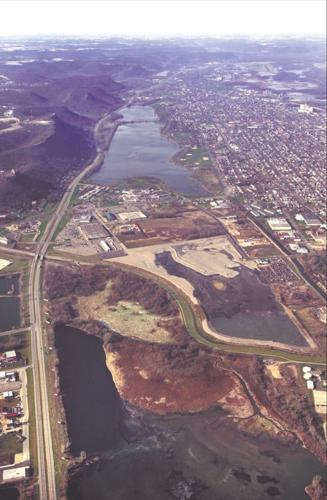
As Detroit churned out cars to feed the demand created by the post-war boom, old routes and old roads proved inadequate to handle the burgeoning traffic. In Minnesota, plans were drawn up to link La Crescent and the Twin Cities with a fast, four-lane traffic corridor. In the Winona area, that meant running the new highway along the south shore of Lake Winona, parallel to Lake Boulevard. Highway 14 would split off at Pelzer Street, heading up the hill as always, but Highway 61 would continue on a new path, well south of Goodview then skirting Minnesota City, eventually merging with the old river road.
People are also reading…
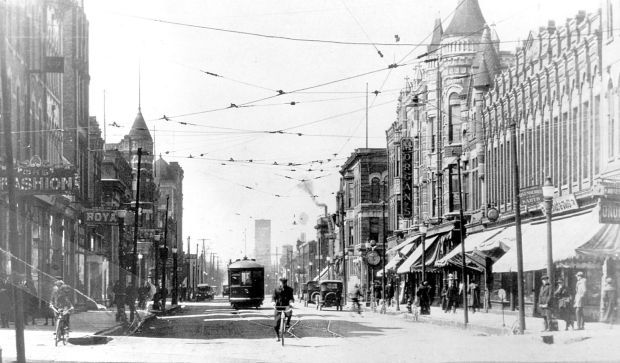
The new road cut through an undeveloped countryside. The lights of the Hot Fish Shop shone at the new road’s east end, and to the west was a filling station serving traffic on Highway 14. On the west, the 5-year-old Thurley Homes sat lonesome in what had been a corn field. Doing business in Winona meant going downtown. Hotels, restaurants, department stores lit up the historic riverfront business district, while the land along the new highway was lit only by the moon and passing headlights. Silent but for the frogs.
But not for long. As evening approached, the lights of a roadside motel drew tired travelers like June bugs. Eliminating the need to navigate unfamiliar city streets, with parking literally at your doorstep, these new lowslung lodging houses had no trouble competing with traditional downtown hotels. Tired travelers were hungry travelers, so restaurants sprang up to sate their appetites, and with the commercial frontier thus breached, other business be soon to followed. It was a pattern set along thousands of roadsides in thousands of communities across the country. Winona was no exception. Mayor Loyde. E. Pfeiffer was one of the first to profit from the development opportunities offered by the new highway. Pfeiffer and A.M. Dramer sold a parcel of land 600 feet deep with 1,000 feet of highway frontage to Sterling Builders of Austin.
Lights go on in the west
In early November 1958, trenching equipment went to work running sewer and water lines to the land at the base of the bluffs just east of where Gilmore Avenue crossed the new highway. In short order, construction began on a 21-unit motel. The new motel, christened the Westgate, opened April 25, 1959, under the management of Doris and Bert Elefson, former managers of the Sterling Motel in Austin. The motel offered 11 units with a double bed and 10 with two doubles. All were carpeted and air conditioned, and there was a television set in the motel lobby. “I hope they use Westgate for the name of the shopping center here,” Bert Elefson told the Winona Daily News, pointing out that sharing a name with the Austin shopping center had been good for business.
The adjoining retail center would take the name Westgate when the first stores opened seven months later. Farley’s Super Valu and Carl Ruge’s Ben Franklin were the first to open their doors in the new strip mall.
Farley’s boasted the latest in grocery retailing — an in-store bakery, doorless dairy cases, and four checkout lanes equipped with automatic change-makers, each capable of checking out up to $500 worth of groceries every hour.
Just down the road from Westgate, the evening sky took on a golden glow. Over the objection of several neighbors, the owners of the new drive-in on West Service Drive were allowed to erect a distinctive sign on either side of their little red and white tiled building. Fifteen cents bought a hamburger, and fries were a dime when the first McDonald’s opened up on Service Drive.
By the mid-1960s, developers were toying with a new concept in shopping centers. Rather than stringing stores out along the perimeter of multi-acre parking lot like an ersatz city street, why not put them all under a single roof, opening onto a indoor courtyard, the whole thing rising like a retail oasis from acres of free parking.
Like a miracle...
On June 3, 1965, the Miracle Mall opened on a 26-acre site between Gilmore avenue and the highway, just blocks away from the campus of the College of St. Teresa.
The Mall boasted over two acres under one roof and was the first enclosed mall in the country to be anchored by a full scale Montgomery Ward department store and a Tempo discount mart. The new mall also was home to the city’s second Ted Maier Drug store and the second Albrecht’s Fairway Foods, along with several smaller shops and an indoor sidewalk cafe.
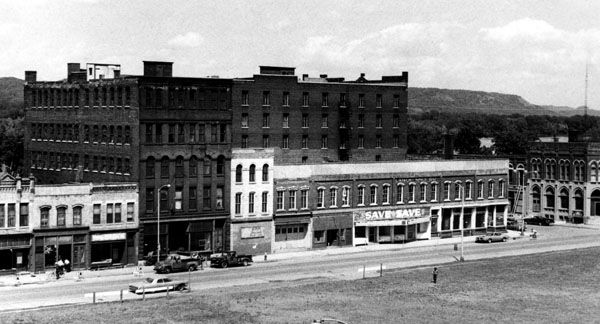
The mall’s opening was the first serious challenge to downtown as the city’s retail center. Wards closed its downtown store to move to the mall, and the downtown Gambles store closed in deference to Tempo, also owned by the GambleSkogmo corporation.
The next major retail defection from downtown came in 1970, when JC Penney opened a 115,000-square-foot retail complex at the corner of Highway 61 and Pelzer Street. The store, the last free-standing retail center built by Penney’s, included a full supermarket, auto service center, garden center and beauty salon as well, as a full-line JC Penney department store.
By the time Penney’s opened its doors, the retail migration to the growing roadside strip was well under way. Gibson’s, later Pamida, opened a discount department store at the Westgate shopping center. Westgate also attracted a new bowling alley, beauty salon, paint and decorating center, book store and Radio Shack store. Kelly’s furniture opened a large store at Westgate, and in 1966 a Cock-a-Doodle-do restaurant opened on a site that would be occupied by a succession of franchisees and independent restaurateurs over the next 35 years.
Kmart rattled Winona’s retail establishment in 1977 with the announcement of its intention to build a major new shopping complex on the marshy land just east of the Miracle Mall. The plans called for filling 12.7 acres to make room for a Kmart retail center, supermarket and additional small retailers, all in an enclosed mall. Ground was barely broken when the project was brought to a screeching halt by legal action taken by the Corps of Engineers and federal environmental agencies objecting to the loss of wetland to the project. The objections would set the project back by more than a year and confine it to a 7.4-acre site immediately east of Miracle Mall. The store opened in April, 1980, and would be the first of several “big box” retailers to enter the Winona market. In the late 1980s, Mills Fleet Farm opened east of Mankato Avenue and Shopko opened west of Highway 14. In 1997, Target came to town, and a major retail center anchored by Menard’s to be built just east of Target is in the planning stage.
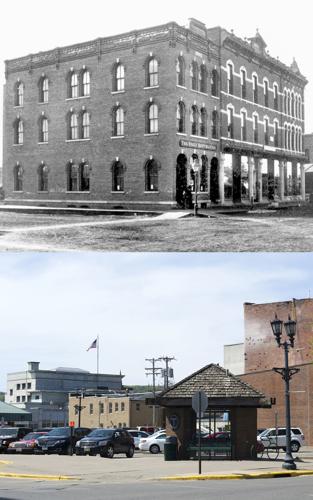
Forty-four years after the highway was rerouted, commercial development has filled virtually every buildable site from the Black Horse to Minnesota City. Over the years, downtown has moved out of town, in effect creating a four-lane, high-speed main drag in and out of the city.


