


In the summer of 1870, Winona was a city of about 7,000 people and about to get its first gas works.
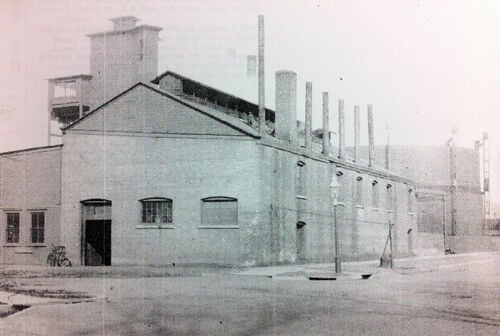
The Winona Gas Light Co. was organized with a paid up capital stock of $60,000 on Aug. 8, 1870, and the new company announced the gas works would be located at Third and Huff streets.
This announcement aroused both favorable and unfavorable comment among the citizens of Winona. Residents in the immediate vicinity of Third and Huff were worried about the “noxious odors” that might result; others outside the proposed vicinity of the gas works hailed the new development as a progressive and welcome move.
To alleviate fears of the first group, officers of the Winona Gas Light Co. held several public meetings and discussed with the townspeople just how the gas works would operate and the benefits that would be derived from installation of a coal gas plant in the city.
People are also reading…
By the spring of 1871, the gas works was completed under the supervision of James Walker, superintendent of the Milwaukee gas works. On April 9, 1871, the first gas was sent out to consumers.
Early accounts of the Third and Huff street works describe the gas house as consisting of a combined retort and purifying house separated by a brick wall. The building was 30 feet by 31 feet, 17 feet high and contained three benches with 18 retorts for carbonizing coal. The purifying house was 24 by 23 by 17 feet, four purifyers. The meter room where all the gas was measured was located at the west end of the building.
The first mains for coal gas were laid along Second and Third streets a short distance from the gas works and gradually extended into the residential districts as demand grew. Residents were required to apply for gas service and when a sufficient number of applications were received in a certain district, pipes were laid by the gas company.
At first about 3,450 cubic feet of gas was consumed daily in Winona, but by 1882, this had increased to 30,000 cubic feet per day.
The 30,000 figure covered both consumption by private subscribers and the city of Winona, for by this time Winona had an extensive street lighting system using coal gas to replace its coal oil lamps.
The “old lamplighter” first began making his rounds in Winona with coal gas lights in April 1871, at which time The Winona Republican commented: “Winona took its first view of herself under the gas light on Monday evening April 3. The gas is a success from the start. However, the flame was not as good as it will be when the air is out of the mains and the works has been in operation for a few weeks.”
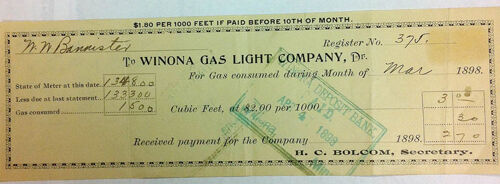
In 1882, consumers were paying $3 per 1,000 cubic feet and the city paid around $25 a year per lamp for its 106 lamps. The Winona Gas Light Co. supplied posts and lamps to the city at cost. Around 30 coal oil lamps were still operating in Winona in 1882 in areas where gas mains had not yet been laid.
The gas company burned about 800 tons of coal in 1882 to supply the daily 30,000 cubic feet of gas to its customers. A major change came in 1905 when the Winona Gas Light and coke Co., was incorporated as a Minnesota company and acquired the property and asset of the Winona Gas Co.
On Dec. 1, 1914, the Wisconsin Minnesota Light and Power Co. took over the system and operated it until Dec. 29, 1923, when Northern States Power Co. purchased the property and assets.
During the time the Wisconsin Minnesota Light and Power Co. operated Winona’s gas system, a revolution was sweeping the country and beginning to be felt in every part of the world. This was the shift from gas and other types of illumination by flame to the incandescent lamp lighted by electricity.
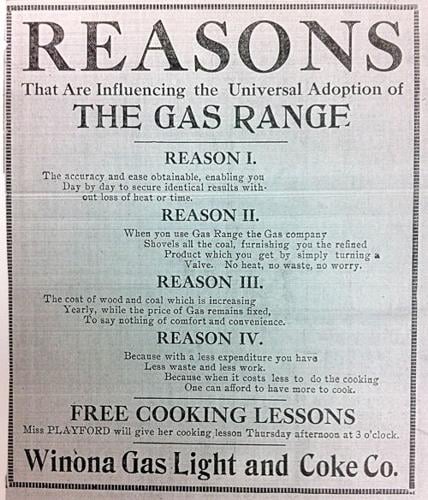
In Winona, as elsewhere, electricity gradually replaced gas for lighting purposes and the gas company began to sell more gas for burning appliances.
Through these years when gas consumption was rising steadily — through its use for water heaters, refrigerators and ranges — continued expansion of the gas works at Third and Huff streets took place. The number of benches was increased to seven, bringing the number of retorts to 42. Coal consumption jumped to many tons annually. Storage space had to be increased greatly at the gas works and modern equipment installed.
In 1946, NSP installed an 18,000 gallon propane gas storage tank at its plant. From this point on, propane gas was mixed with its coal gas to augment the company’s coal gas supply.
In September 1948, the entire gas system was changed to propane air gas and the use of coal gas discontinued. This change-over meant bringing in tankcars of propane gas — 10,000 gallons to a car — to Winona instead of coal. All gas appliances in Winona had to be converted to accommodate the new gas and this was done by NSP during the summer of 1948.
In the mid-1950’s natural gas pipelines reached Winona, and NSP converted its distribution system to natural gas.
From the Winona Daily News Centennial Edition, Nov. 20, 1955.
From the Winona Daily News Centennial Edition, Nov. 20, 1955.


