


Fifty years is nothing in the life of a cathedral. But it is the greater part of the lifetime of those who build cathedrals.
Fifty years ago, on a sunlit April afternoon, Bishop Edward Fitzgerald, fourth bishop of the Diocese of Winona, sprinkled the newly laid foundation stones of the Cathedral of the Sacred Heart with holy water, calling upon God that “this place may be dedicated to prayer and to invoking and praising the name of Jesus Christ.” “In the faith of Jesus Christ we place this cornerstone in this foundation,” Fitzgerald intoned.
The cathedral church plays a unique role in the liturgical life of the Roman Catholic Church. The name comes from cathedra, the name given to the chair from which, historically, the bishop promulgated the teachings of the faith and administered the affairs of the diocesan church entrusted to his care. In each diocese there is one, and only one, cathedral church.
People are also reading…
But throughout its first six decades, the Diocese of Winona was without a proper cathedral.
Catholicism came to Winona with the first German and Irish settlers in the early 1850s. A mission church, named in honor of St. Thomas, was built in 1857, and the city’s first resident priest, Rev. Michael Pendergast, arrived the next year. In 1864, the church was moved closer to the middle of town from its original location on Dakota Street near Mark Street to a lot near the corner of Wabasha and Center streets. A new church was completed in 1871.
Ethnic differences soon surfaced in the community’s growing Catholic population. As early as 1858, German Catholics began organizing themselves in hopes of establishing a parish where they could confess and be taught in the language of the old country. They raised $400 to buy a lot at the corner of Fifth and Walnut streets and by 1862 had erected the Church of St. Joseph, with the Rev. Theodore Venn the first pastor.
In 1889, the Rev. Joseph Cotter was consecrated bishop and assigned to his newly created see in Winona. The bishop designated the Church of St. Thomas the Pro-Cathedral, the temporary cathedral, of the new diocese.
The need for a more suitable, permanent cathedral church was recognized by Cotter and his successors, but other, more pressing needs, kept the bishop’s chair at St. Thomas.
In early 1943, Bishop Leo Binz, recently appointed as diocesan administrator to assist the ailing Bishop Frances Kelly, proposed establishing a building fund for a new cathedral church. A year later a full scale fund drive was launched, with a goal of seven times the annual diocesan tax collected from each parish and mission. In 1945, parishes were instructed to give the cathedral drive priority over all other projects. When the campaign concluded at the end of 1946, nearly half a million dollars had been collected.
But raising money proved less a challenge than finding a place on which to build.
A number of people suggested that the diocesan church be built in a city more centrally located in the long narrow shoestring of southern Minnesota counties that make up the diocese, but ultimately the decision was made to keep the cathedral in Winona.
But finding a site in Winona where soil conditions would support the weight of a massive stone cathedral proved a challenge as well. Ultimately the new cathedral would have to wait for a new bishop.
On Jan. 3, 1950, Bishop Edward Fitzgerald was installed as the fourth bishop of Winona, pledging on the day of his installation that the cathedral would soon be built.
As he made that pledge, Fitzgerald virtually looked out on the site of the new church. In short order, the diocese would acquire three residences adjoining the grounds of the pro-cathedral. The new cathedral, dedicated to the Sacred Heart of Jesus, would be built in the shadow of the old.
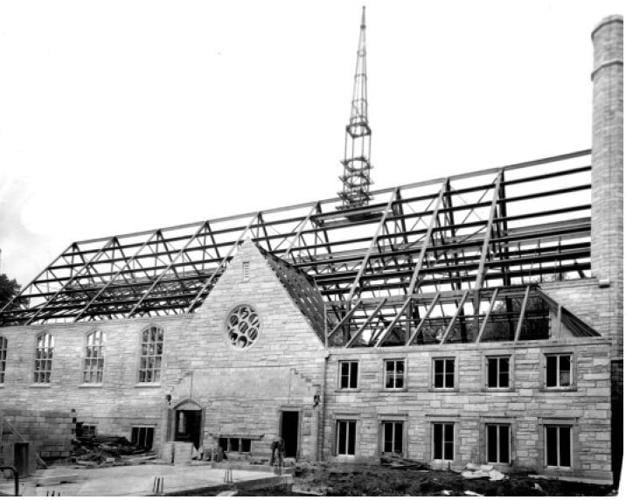
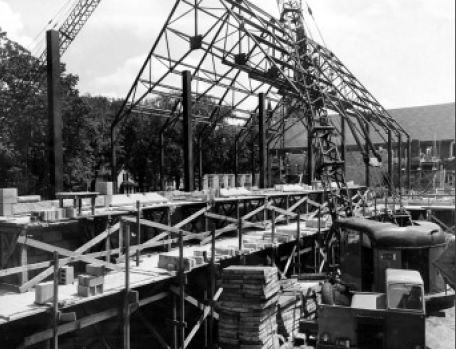
On June 15, 1950, Pope Pius XII granted a petition to merge the parishes of St. Thomas and St. Joseph to create the Cathedral parish. Ground was broken Nov. 26, 1950.
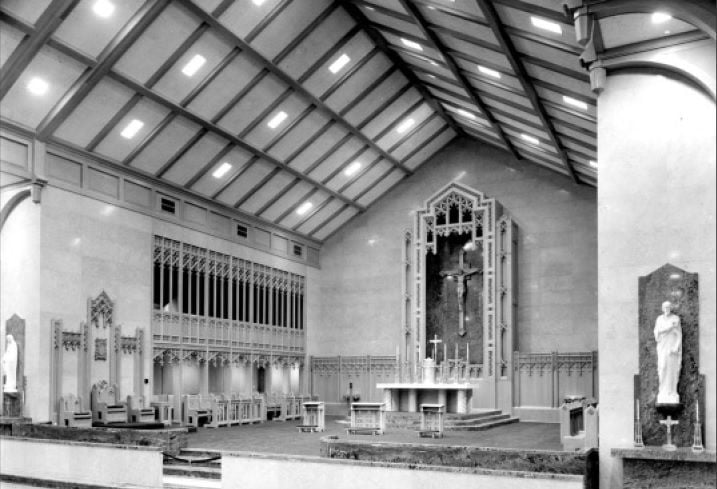
The church was designed to be straightforward and functional, 200 feet long, 60 feet across, with a seating capacity of about 1,000. The ridge of the nave rose 39 feet above the heads of the congregation. The altar was made from a 12-ton slab of Botticino marble, 11 feet long, inscribed with the words “Ego Sum Panis Vitae” — I am the bread of life.
On Saturday morning, Oct. 25, 1952, Bishop Fitzgerald blessed and dedicated the altar and celebrated the first Mass in the Cathedral of the Sacred Heart. With him at the altar was a 13-year-old altar boy, Bob Kierlin.
“About six of us got to serve that Mass,” Kierlin recalled. “The general public didn’t know about it, so there weren’t many people there. The Sunday Mass was the big one with all the pomp and circumstance.”
Fitzgerald celebrated that Mass for the annual meeting of the diocesan Council of Catholic Women, but the ladies sat on folding chairs and knelt on the floor. Not even a cathedral is immune from shipping delays. The pews would not arrive for another month.
“The Cathedral was born in the mind and cradled in the arms of Bishop Fitzgerald,” Bishop William Mulloy said in his homily at the dedication Mass on May 6, 1953. “For generations yet to come this edifice will be a channel through which the divine life will continue to flow into the souls of men. It stands on a firm rock foundation of faith, love, and hope of the people of the diocese.”
This story was first published Sept. 16, 2001.


