


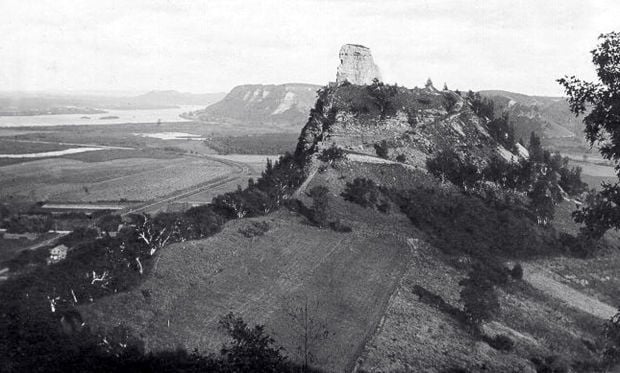
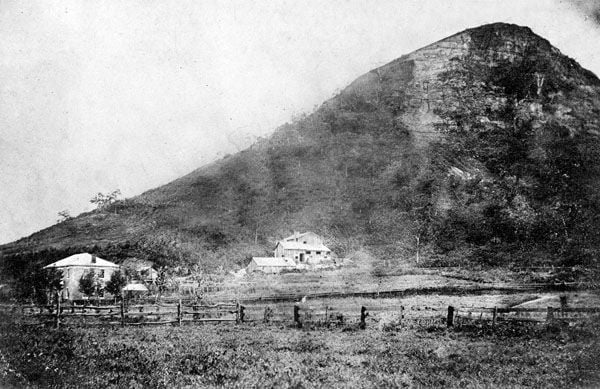
If Winona had needed a few more miles of sidewalk in the 1880s, Winona’s most famous landmark might be called Pool Table instead of Sugar Loaf.
The lump of rock on a flat-topped plateau is all that’s left of the limestone outcrop known as Wabasha’s Cap to the Dakotas and the first white settlers.
“The name was given because of its rounded cedar-crowned summits resemblance to a red Scotch cap given to the elder Wah-pah-sha at Mackinaw while an ally of the British and because it dominated the Burns creek and farm, the homestead of Chief Wahpa-sha,” Lafayette Bunnell wrote, recalling its appearance before it fell into the hands of an ambitious Irish quarryman, John O’Dea.
O’Dea settled in Winona in 1857, setting up a building supply store at 116 Market St., selling, among other things lime, cement and stucco. Looking up from his shop he could see, towering nearly 500 feet above the landscape, an all but inexhaustible supply of lime and limestone, just waiting for the right man to haul it away.
People are also reading…
O’Dea decided to be that man.
In 1878, he bought the 32.54 acre parcel that included Wabasha’s Cap and the surrounding hillside. He snaked a road up the back side of the bluff, built a lime kiln and began hewing away at the gargantuan lump of stone.
Over the next several years, quarrymen whittled away at Wabasha’s Cap, turning the landmark into builder’s lime, building stone and sidewalks for the city below. While the people of Winona recognized the usefulness of the products coming down the hillside, they also looked with no small measure of dismay at the dwindling promontory that had guided steamboat men and traders to their town.
“The crown of the majestic Sugar Loaf bluff is disappearing before the strokes of the utilitarian quarrymen,” the Daily Republican editorialized in 1886, “and in a very few years more that widely known landmark will be but a homely reminiscence of its former beauty and grandeur — a sort of muley cow, as it were among a herd of broad horned bulls of Bashan. If the city had a spark of esthetic pride in its composition it would quickly see to it that the adjoining bluffs are not similarly despoiled of their beauty.“
Undeterred, O’Dea kept on quarrying. He was persuaded to stop two years later, not so much due to aesthetics or public opinion as a loss of profitability.
Left atop the mountain was a squared-off, 85-foot lump of limestone. The quarried out hilltop remained in private hands, even as it was adopted as the unofficial logo for the city. In 1897, members of the John Ball Post of the Grand Army of the Republic petitioned the Board of Park Commissioners to “acquire the property known as Sugar Loaf within the city limits, for the purpose of setting it aside as a park and with the further object in view of crowning the bluff, at some future time, with a monument in commemoration of the valor and patriotism of the soldiers and sailors of the city and county of Winona.” Nothing came of the petition.
In 1948, Sugarloaf was up for sale.
Despite public sentiment to the contrary, city attorney S.D.J. Bruski advised the city council they had no means available to buy the 22 acre parcel from the Henry Bohn estate.
Fortunately, the market for limestone landmarks was soft that year, giving the Wenonah Chapter of the Daughters of the American Revolution time to mount a fund-raiser and purchase Sugarloaf for the city. On May 15, 1950, Mrs. George Kissling presented the deed to the city council.
It was 1983 when the rock atop the hill gave the city one more surprise. For the first time, flood lights were set up to illuminate the landmark at night. When the lights were turned on the clear and unmistakable image of a cross, indiscernible in daylight, was defined in light and shadow on the rock face.
Then, about 9 a.m., Monday, February 23, 2004, the old rock took on a bit of a new look.
Tons of limestone sheared off the northwest face of the landmark, leaving a dark trail of rock rubble in the snow, down a lower cliff face and into the tree-covered slope below. The cascade of stone stopped about 100 yards short of the nearest house.
Bruce Fuller, Winona superintendent of parks and forestry, said that it was the first time anything like this had happened in at least 30 years. The layers of stone came loose and fell because of the freezing and thawing action of water over time, he said. Fuller wasn’t concerned about weather erosion erasing Winona’s most unique land form. “If you see early pictures of Sugar Loaf, it hasn’t changed hardly at all,” he said. “Eventually, Sugar Loaf will fall, I envision, 10,000 years from now.”


