


At first thought, a city with only one tree is an unlikely site for a sawmill.
But on second thought, it makes perfect sense ... more than anything else, a town without trees needs lumber.
It was to the good fortune of the Lairds, the Nortons, Youmans and Hodgins that in the second half of the 19th century all across Iowa, Minnesota, Nebraska and the Dakotas towns and farms were springing up where there were no trees.
Across the plains nearly every barn, henhouse, general store, church, school, saloon and bawdy house would be built of lumber, much of it sawn in or sold from Winona.
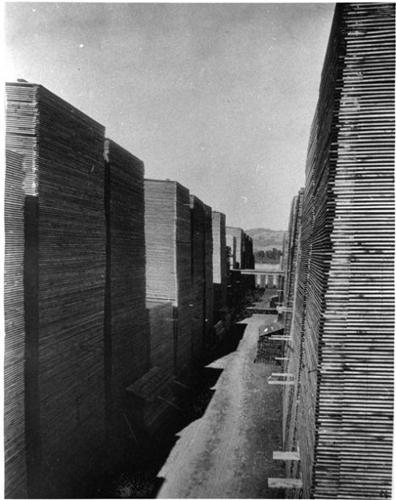
In 1892, at the height of the lumber era,Winona mills would turn out 148,000,000 board feet of lumber and 89,000,000 shingles and laid a plausible claim to being the preeminent sawmilling center of the world.
People are also reading…
Not bad for a town that, when it was founded in 1851, had but a single tree.
Historian Fred Kohlmeyer described Winona as a town “pulled from the river.” The Mississippi was the mainstem of a network of streams and rivers that, in the 1800s, flowed through one of the world’s greatest pine forests.
Logs cut along the St. Croix and Chippewa rivers were sawed in the mills at Stillwater and Eau Claire to be floated south in great lumber rafts to supply the river frontier.
In April 1855, a young Pennsylvania general store clerk,William Harris Laird, traveled up the Mississippi and Chippewa from Winona to Eau Claire to buy lumber.
He floated downriver with his purchase, $1,042.80 worth of lumber, lath and shingles, the initial stock of Laird and Brothers, the first lumber dealers in Winona.
James and Matthew Norton joined the firm in 1856, giving birth to Laird, Norton and Co.
Winona’s first lumbermill followed in the fall.
The mill, built by James D. Hilands and Luther Wyckoff could cut 30,000 board feet of lumber a day.
The enterprise was ill-timed, opening just before the Panic of 1857 brought the boom years of the early 1850s to an end.
Undercapitalized, the mill changed hands several times before it burned to the ground in 1858.
Two years later, in 1860, Charles Horton, Andrew Hamilton and Lemuel C. Porter rebuilt the mill, launching the Empire Lumber Co.
The timing of Laird, Norton’s first mill was even less auspicious than Hilands’ and Wyckoff ’s.
Buoyed by two years of brisk lumber sales, Laird, Norton started construction on a mill of its own during the summer of 1857 and sawed the first log Sept. 1, just in time for the bottom to fall out of the lumber market.
Only a month after the Laird, Norton mill opened, Earle S. and Addison B. Youmans — who for the next 42 years would be Laird, Norton’s keenest competitor — sawed their first log at their new mill built a couple blocks west of Huff Street.
The mills opened into what would prove to be a Biblical seven lean years.
Economic activity and with it the price of lumber would stay depressed until near the end of the Civil War in 1965.
As the war years drew to a close, the general economic revival was complemented by the construction of the first railroads from Winona onto the western grasslands.
Railroads would prove as important to getting lumber to carpenter as the river was in getting logs to saw.
Before the railroad broke out onto the plains, a farmer living 50 miles from Winona faced a six-day journey to deliver a 30-bushel wagonload of wheat to market and haul home a wagon load of lumber.
William Laird was among the first to seize upon the railroads’ potential to open new markets for his lumber.
In 1864, only two years after the first train made the 11-mile trip from Winona to Stockton, Laird, Norton & Co. opened the first retail lumber yards along the tracks of the Winona and St. Peter Railroad in St. Charles and Rochester.
As the rails reached west, the Winona mills supplied yards that stretched across Minnesota into the Dakotas and Iowa.
If the rails proved vital to moving lumber out, the rivers of Minnesota and Wisconsin were critical in bringing the logs in.
Loggers, up to 100,000 strong during the peak years of the lumber era, swarmed the pine woods of Wisconsin and Minnesota every winter.
Wielding two-man crosscut saws and double- bitted axes all honed to a razor edge, lumber jacks could fell a massive pine in 10 minutes flat, then slice through a 30-inch log in 30 seconds flat.
The magnificent old growth pines often yielded four 16-foot logs to a tree, with 18-inches being the smallest acceptable diameter.
The logs were sledded to the riverbank along ice roads to be dumped into the river at spring thaw.
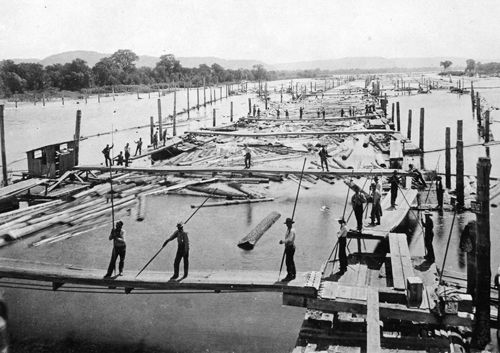
After sorting and grading, the logs were assembled into huge rafts to be floated downriver to the mills.
In the early years, the rafts floated with the current, guided by rafts men working at long sweep oars.
Later stern wheel steamboats took control of the raft, one in back to push it downstream, and a second boat tied sideways to the front to push and pull up to 10 acres of logs around river bends and around obstructions and through bridge piers.
Delivered to the mills, the logs were sliced into planks, boards and timbers; trimmed into lath and shaved into shingles.
Lumbermen expected to cut 1,000 board feet of lumber from every 2½ logs.
The mills were a powerful magnet for an immigrant labor force.
Many of Winona’s Polish community trace their ancestry to men who sawed logs and piled lumber for the Lairds and the Youmans.
During the 1870s and 1880s, a common laborer could expect to earn $1.25 for an 11-hour day in the Laird, Norton mills.
Labor relations in the mills were remarkably good.
Kohlmeyer noted that “in Laird, Norton Co.’s voluminous correspondence files there is never any mention of a labor shortage or a strike.
They were as free from ‘labor troubles’ as any industrial enterprise could ever hope to be.” The pine forests were not inexhaustible, and by the middle years of the 1890s, their yield went into precipitous decline.
Faced with the inevitable decline, Youman Bros. & Hodgins sold off its pinelands along the St. Croix and closed out milling operations in 1898.
Laird, Norton closed down its mill in 1905.
The Hayes- Lucas mill continued two years longer, until 1907.
In 1909, the Empire Lumber Co. closed its mill, 54 years after Hiland and Wyckoff cut their first log at the same site.
Six years later, in 1915, the Ottumwa Belle pushed a lumber raft scavenged from abandoned mills along the Mississippi and its tributaries past Winona and south, marking the end of the lumber era.


