


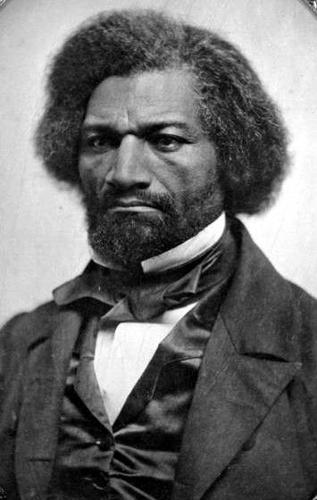
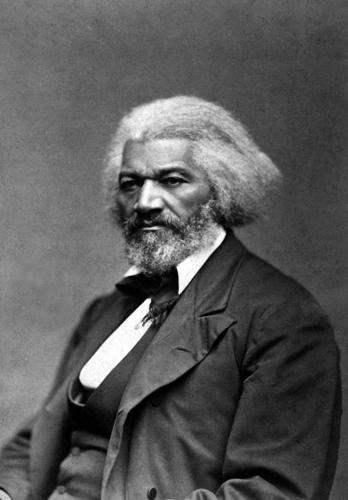
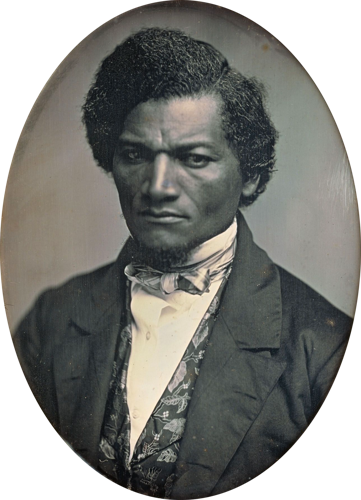
The lecture by Frederick Douglass, on Saturday evening, under the auspices of the Young Men's Library Association, was one of the most successful public gatherings, as it was unquestionably the largest of the kind, ever held in Winona. Philharmonic Hall, the most spacious assembly room in the city, was fairly crammed with people, many of whom came from distant points in the country and from neighboring towns and villages in this state and in Wisconsin, to hear the renowned champion of the colored race.
For nearly two hours and a half, Mr. Douglas entertained his auditors so well that the utmost silence prevailed, and not a person left the hall although it was densely packed. The subject of the discourse was "The Dangers that Beset the Republic." These dangers, Mr. Douglas portrayed in a masterly manner. The comprehensiveness of the federal Constitution — its freedom from bigotry, from sectarian prejudices, from cast, from political distinctions, it's ample provisions for the protection, development and vindication of manhood under whatever guise and in every emergency — were described with graphic power. In the eye of that great instrument, the Constitution, we are neither Jew nor Greek, barbarian nor Cythian, black nor white, but fellow citizens of a common country, embracing all men of all colors. The fathers of this republic did not learn to interpolate the word "white," nor to determine the measure of men's rights by the shade of their complexion. They did not base their legislation upon the differences between men in the length of their noses or the twist of their hair, but upon the broad fact of a common human nature. At no time within the past 50 years could we have received a Constitution so liberal from the sons as we have received from the fathers of the republic.
People are also reading…
Some have undertaken to prove that identity of the Negro with the monkey, or the relationship, from the length of the Negro's heel — forgetting, what is the fact, that the monkey has no heel at all, and that the longer a man's heel is, the father he is removed from the monkey. The fathers of The republic were two large minded to descend to such nonsensical distinctions. For this they are entitled to the profound gratitude of mankind — that against all temptations to do otherwise, they conferred upon us a wise and liberal Constitution.
From this view the lecture passed onto an exhibition of the defects which exist in our system of government as it has been administered and of the danger is which surround the republic because of these defects. The absurdity of limiting the humane provisions of the Constitution was impressively set forth.
The abuse of exercise of the veto power in this republic, and contemptuous disregard of Congress and the people, was forcibly contrasted with the more liberal and judicious use of executive power under the British monarchy, which has never, for 150 years, although the right exists in in law, presumed to place a veto upon the will of the people as expressed through Parliament. The disastrous experience of the republic from the sudden accessions of perfidious vice presidents to unrestrained executive power by the death or assassination of faithful presidents, was portrayed in the startling narration of facts touching the administrations of Harrison and his successor Tyler, of Taylor and Fillmore, of "Jeemes" Buchanan — who it will be recollected came near being the victim of poison as bad as has been shrewdly suspected for the benefit of Breckenridge and the southern fire eaters, and lastly, and most sorrowful of all, the administrations of Abraham Lincoln and Andrew Johnson. The vice presidency as well as the veto power, the lecturer would abolish.
The people do not need checks, they can be trusted with their own destinies; and hence the veto power is an anomaly in our form of government. So, also, is the vice president — Aa useless piece of governmental furniture, a mere inducement to assassination. Such were the views of the lecturer. They were presented with force, and in most instances commended themselves to the approval of his audience.
At one stage of his address, Mr. Douglas took occasion to step aside from the main argument to rebuke a mean and cowardly insult which had been publicly cast upon him in coming here. Some of the audience, not knowing the facts, did not perceive the drift of the speaker's remarks; but those who did will doubtless agree with us in concluding that the author of this insult, if he was present and heard Mr. Douglass' scathing review, will he feel his long ears tingle in consequence down to the last moment of his existence.
The closing appeal of Mr. Douglas in favor of the exercise of good faith to the loyal colored man of the south, who came to the rescue of the republic in its hour of extremest peril, and his eloquent advocacy of a large-hearted application of the principle of civil liberty to men of every nationality, were exceedingly fine, and elicited enthusiastic applause from the audience. It is sad — it is sad — to think that half the glory, half of the honor, due to the great act of emancipation was lost in the tardiness of its performance. It has now gone irrevocably into history, not as an act of sacred choice by a great nation — of the right as against the wrong, of truth as against falsehood, of liberty as against slavery — but as military necessity!
We are called upon, he continued, to be faithful to the American government for our emancipation as black men. We do feel thankful — and yet we have the same reasons to be thankful that the Israelites had to be thankful to Pharaoh for their emancipation. It was not until judgments — terrible, wide sweeping, far reaching, and overwhelming — had smitten down this nation, that we were ready to part with our devotion to and reverence for slavery, and cease to quote scripture in its defense. It was not until we felt the land trembling beneath our feet that we heard accusing voices in the heart. The sky above was darkened; the wail came up from the four millions of hearthstones in our land. It was not until then, when our sons and brothers were slain in battle, when we saw them returning home mere stumps of men — armless, legless, and bowed down — it was not until we felt our very hopes dissolving, and saw the Star-Spangled Banner clinging to the masthead heavily bedewed with loyal blood — it was not until all this had come upon us that we were magnanimous enough to part with a reference for slavery, and courageous enough to put a musket on the shoulder of the black man. Happy will it be for us — happy for the land — happy will it be for coming generations, if we shall now contemplate from choice the work which we began under the pressure of a stern military necessity.


