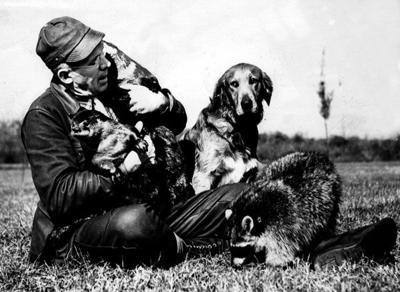

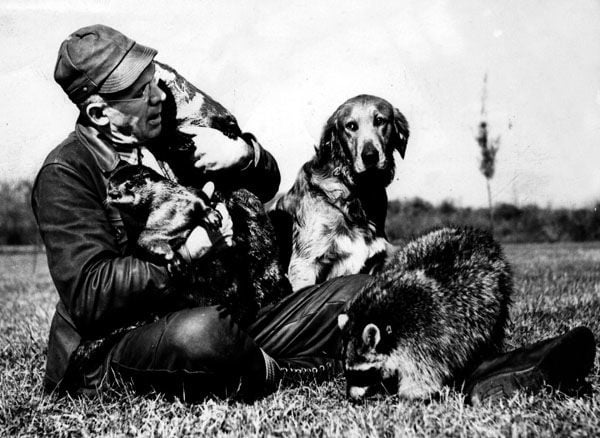
Two orphan otter cubs lead to a lifetime vocation for Emil Liers.
The two cubs he found along the riverbank touched his heart, and although it involved getting a special permit, he kept and cared for them. In time, more than 100 otter slid through his life and either became a part of the pack that roamed about his otter sanctuary near Homer or went on to live in zoos or private homes.
Prior to Liers, no otter had survived in captivity for more than a year at the most.
"He was the first man to breed an otter in captivity," said Budt Safranek, a longtime friend and hunting partner.
Eventually, Liers had nearly a dozen otter that he trained to retrieve things and go up and down slides in a custom made pool and playground.
"He had an otter we took hunting because it would retrieve ducks," Safranek said. They would take many otters with them when they went fishing, too.
People are also reading…
"One time when we were fishing, and Silver came back and made this certain sound she made when she wanted attention. She had a massassagua rattlesnake in her mouth, and it was alive!"
In a 1942 interview with the Saturday Evening Post, Liers told how otters are expert rattlesnake killers, like their smaller cousins, the mongoose. He said he saw his otters kill and eat hundreds of rattlesnakes and never once get bit.
"They’d swim and dive and find crayfish," Safranek said. "Emil’d whistle, and they’d come back."
Liers did more than just train his fun and furry pals -- he studied them. It's safe to say that before Liers, the science world had very little accurate information about otters.
In fact, in November 1939, Liers was arrested by the Fillmore County game warden on a trumped up charge that boiled down to the fact that many area anglers felt that his pack of lutra candensis were gobbling up too many fish.
Liers was downright evangelical in proclaiming to the court that otter, in fact, eat very few, if any fish. The first cubs he and his family raised, Toquesh and Nashtash, ate table scraps and "people food." Liers’ discoveries and ability to observe the otter and let nature take its course resulted in his landmark successes in raising and breeding otter in captivity. Over the years, Liers and his wife, Lillian, refined the otter diet, and he sold otters to zoos in New York, Chicago, Washington and Traverse City, Mich.
Newspaper accounts of Liers court hearing show that he never missed an opportunity to show off his beloved otters. After the charges were dropped due to lack of evidence, he entertained the court room with two of his otter films.
In fact, Liers otters were some of the first actors from Winona to make the Hollywood big time. In 1951, Disney Studios featured Liers otters in the nature film "Beaver Valley." Liers critters took leading roles in a number of nature films. His otters were featured in stories in Life magazine and The Saturday Evening Post.
Liers books introduced millions of children to otter, beaver, mink and black bears. His book "A Black Bear’s Story” was honored with the 1962 American Library Association Award.
Liers was hired by the University of Minnesota to go around to schools all around Minnesota and the United States.
“He'd be on stage and the otters would be in the back of the auditorium and come down the aisle to him," Safranek said.
Despite the attention, Liers "never went Hollywood." Once a shopping center in Detroit offered him $500 a day plus expenses to perform at its grand opening. He declined because it was woodcock season.
"He had his priorities straight," Safranek said.
Emil Liers was 85 years old when he died in October 1975. He was survived by his daughter and two otters.