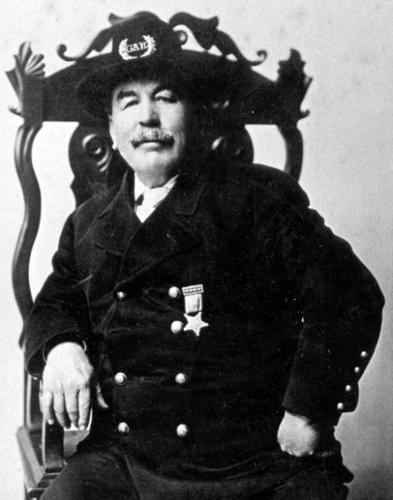

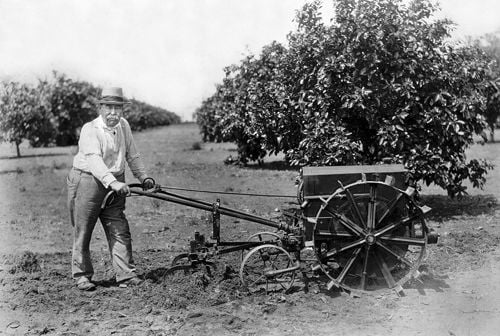
One hundred years ago this month, Samuel R. Van Sant laid his right hand on his father’s shoulder and was sworn in as the first, and so far the only, governor of Minnesota from Winona.
“I remember Mr. Van Sant well,” Winonan William Codman recalled in 1950. “He was know as Captain Van Sant and had the ruddy face of a riverman. He was not very tall, but extremely stocky, broad and fleshy. He was a jolly man and made people feel good.”
“He had three passions,” his grand nephew, Benjamin Van Sant, said in 1965, “His family, the river, and his country.”
By any measure, his life was extraordinary.
Born to a boatbuilder and part-time preacher, his innovations revolutionized transportation on the Mississippi River.
A successful businessman, he would, as the Republican governor of Minnesota, do battle with the most powerful business interests of his day.
People are also reading…
He was a soldier who went to battle against the wishes of his father, and devoted the latter years of his life to fighting for the interests of his aging comrades.
Samuel Rinnah Van Sant was born to John Wesley and Elizabeth Van Sant on May 11, 1844 at Rock Island, Ill.
The elder Van Sant, a boatwright by trade, was the first of seven sons, all of whom followed the example of their father and grandfather and entered the Methodist ministry.
The family’s religious fervor left an indelible mark on young Sam’s character.
Though he lived his life in the hard cussing, hard drinking world of river rats and politicos, Sam Van Sant was never know to take a drink of hard liquor and in later years was ardent in his support of prohibition.
Shortly after Sam was born, the John Wesley moved the family across the river to settle in the Iowa community of Le Claire Situated just upstream from the Rock Island rapids, LeClaire was home to the Davenport and Rogers Boatworks.
Steamboats and other craft damaged picking their way through the shoals, pulled up in LeClaire for repair and recaulking while their crews retired to the village’s ten saloons.
John Wesley Van Sant plied his trade in the boatyard, while young Sam hung around the yards learning the trade and soaking up the lore of the river.
“He had it in his bones,” Benjamin Van Sant said. “The first dollar he ever earned he spent for a skiff.”
When Mr. Lincoln called for volunteers to put down the southern rebellion, 16-year-old Sam Van Sant did his best to volunteer, but, was turned away because of his age.
It took a year to persuade his father, but in August of 1861 he signed up with Company A, Ninth Illinois Cavalry.
“He was in many hot engagements,” Ben Van Sant said. “It is recorded he fought hard and well and sent home most of his pay.”
At war’s end Van Sant mustered out with a corporal’s stripes on his sleeve.
Inspired to higher education he enrolled in Burnham’s American Business College in Hudson, New York, and then in Knox College in Galesburg, Ill.
But academia couldn’t compete with the pull of the river. When Sam Van Sant learned his father was considering buying a one-quarter interest in the boatyard, he hurried back to Iowa.
Samuel went into partnership with his father, and, after scouring the community for cash, they bought the boatyard outright.
The lumber boom on the upper Mississippi was underway.
Huge rafts of logs and lumber floated on the river, and mill owners, all too aware of the short shipping season available to them, couldn’t wait for the current to float them along the channel.
But the side-wheel steamers commonly in use were all but useless in steering the huge log-booms in the river’s swift and tricky current.
Van Sant came to believe that a sternwheeled boat of sufficient size and power could master the rafts and the river.
In May of 1870 he launched the J.W. Van Sant, 100 feet long, 20 feet abeam, built in the Van Sant’s LeClaire boatyard.
“The boat handled like a skiff,” Benjamin Van Sant said, “They were able to do things with it they had never been able to do with rafting boats before.”
A revolution on the river had just begun.
The J.W. Van Sant was the first of what would eventually become a fleet of over 90 boats pushing logs and lumber up and down the Mississippi, a goodly number of which were owned and operated by J.W. Van Sant and Son.
“It was said he could get more rafts down the river in less time and with less trouble than anyone else,” Benjamin Van Sant said.
The lumber mills along Winona’s riverfront were prime clients for the Van Sant rafting boats.
In 1883, Samuel Van Sant moved with his wife and son to Winona to be closer to some of his biggest clients.
He hit it off with the movers and shakers of his adopted city and before long was drawn into local politics, serving on the city council and making an unsuccessful bid for mayor, running as a Republican in a decidedly Democratic year.
In 1892 he was first elected to the Minnesota house, and in 1865 was made speaker.
“He found it was almost as much fun to steer a political ship as it was to steer a steamboat,” his grandnephew said.
Codman said that Van Sant “made no secret of his political ambitions. He wanted to be governor and didn’t care who knew it.”
In 1896 he stumped the state, but came up short in the state Republican convention.
“It is an honor to be even mentioned at this convention,” Van Sant told the delegates, “But I assure you, I was not really running for governor, I was only walking.”
He tried again in 1898, again losing out on the nomination.
But in 1900, after four years of campaigning, the delegates handed Van Sant the nomination by acclamation.
He ran against Democratic incumbent “Honest John” Lind, known for his populist policy, and in an election that took days to decide, squeaked out a 2,500 vote victory.
On his inauguration day, instead of putting his hand on the Bible as he took the oath of office, he laid his hand on the shoulder of his 91-year-old father.
As a Republican governor, he was somewhat of a surprise.
He took up the cause of tax reform, and fought to preserve some of what little remained of Minnesota’s forests.
He instituted the state board of control to regularize the administration of state government departments and oversaw the establishment of the State Game and Fish Commission.
And he dared to take on the railroads.
As Van Sant took office, St. Paul railroad tycoon James J. Hill and New York financier J.P. Morgan were in the midst of a maneuver that, if successful, would give them control of virtually all rail traffic between Minnesota and the Pacific.
In a battle waged on Wall Street Hill, owner of the Great Northern Railway, grappled with E.H. Harriman, owner of the Northern Pacific, for a monopoly that would span six states.
In St. Paul, Minnesota governor Samuel R. Van Sant observed that the two rail lines were “parallel and competing” and that the constitutions of the State of Minnesota and the other six states explicitly barred creation of such a monopoly.
On Jan. 7, 1902, Van Sant directed the attorney general to file suit to block the combination.
His opposition roused Hill’s ire.
The “Empire Builder” considered his home state the first province of his business domain and refused to let the challenge go unanswered.
He denounced Van Sant as “the enemy of prosperity and stability” and warned that “not in 50 years will Minnesota recover from the blow.”
In the face of Hill’s fierce opposition, the election of 1902 “was a dismal, dreary, uphill fight” for the governor.
On election day, Van Sant returned to his Winona, resigned to defeat.
Instead, he carried the state by 60,000 votes.
In 1904, Van Sant saw his position ultimately vindicated when the U.S. Supreme Court, in Northern Securities Co. v. the United States, ruled the railroad magnate’s action had violated the Sherman Anti-trust act.
After two terms, Van Sant declined to seek reelection.
He sold his home in Winona and took up residence in St. Paul where he tended to business affairs and devoted considerable energy to the Grand Army of the Republic (GAR), the organization of Union Civil War veterans, lobbying for government benefits for veterans and their families.
In 1910 he was elected national commander in chief of the GAR.
He continued to be an active member of the community, and his annual birthday walk from the Leamington Hotel in Minneapolis to the state capitol in St. Paul, was an annual feature in the Twin Cities newspapers.
He was slowed somewhat by a stroke in 1933 and died in 1936, aged 92.