


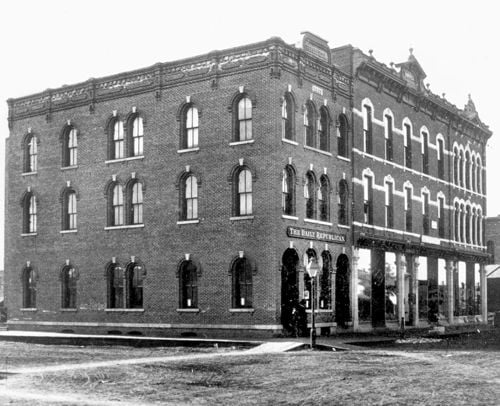
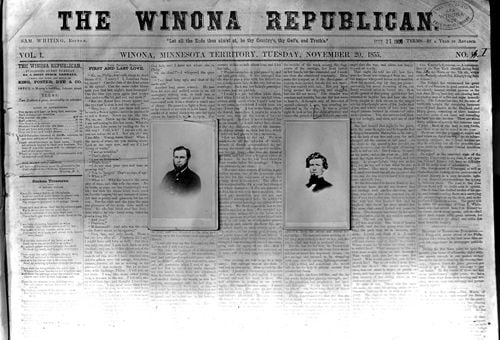
Many newspapers have lived and died in Winona during the 100 years since The Daily News began publication as The Winona Republican.
Most of them started up in the first 25 years of the city’s life, in the days when every group wanted a newspaper to voice its views, political or otherwise.
Few ever lived beyond a few months.
In the pioneer days of Minnesota, starting a newspaper was comparatively easy and required a relatively small investment.
All an editor needed was a few type fonts, a small press, a supply of ink and a handy way with words.
But keeping a paper going and profitable was a precarious business and still is for that matter.
Because there were so many newspapers in communities like Winona, competition for the advertiser’s dollar was sharp and there simply wasn’t enough money around to support so many publications.
People are also reading…
Too, may advertisers and subscribers, who were also pioneers and struggling to eke out a living, occasionally forgot to pay their bills.
Notices to “pay up the printer” were frequent.
Between the time the first newspaper, The Argus, was published in Winona in 1854 and the year 1900, 13 new papers started publication.
Each lasted only a short time.
Argus in 1854
The Winona Argus was established in the fall of 1854 by William Ashley Jones & CO. and published each week for three years.
Capt. Sam Whiting, who later became the first editor of the Winona Republican (now the Daily News) was editor, and Samuel Melvin, foreman. The Argus was Democratic in politics.
The second local news venture was the Winona Weekly Express.
This was founded in 1855 by Henry D. Huff.
The Express backed David Olmsted for the delegate to Congress from the territory of Minnesota.
When Olmsted was defeated, the columns of the Express were dressed in “mourning” (wide black rules between the columns) and soon after that, publication ceased.
The press and printing materials of The Express were sold to the founders of the Winona Republican, the third paper established in Winona.
Suspension of The Argus left Winona without a Democratic paper.
To fill this gap, The Times, a Democratic weekly, was established early in 1858 by J. Ketchum Averill.
Footloose Capt. Sam Whiting also served as editor of this paper.
This paper lived only until July 1858.
A short time later, the Democrat was founded by C.W. Cottom of Rochester, Minn.
It, too, lasted only a few months.
The Tri-Weekly Democrat succeeded the Democrat, with C.W. Cottom, editor; J.L. Thompson, printer and W.T. Hubbell, city editor.
The paper was forced to suspend publication after two years.
Winona’s first daily paper was started in the summer of 1861.
It was The Winona Daily State, but remained a daily for only a month and was then changed to a weekly which lasted a little over a year.
The Winona Weekly Democrat, a weekly, was established by Andrew J. Reed in 1864.
One of his fellow Democrats was unkind enough to go around town predicting that the new paper wouldn’t last more than three months.
Editor Reed advised this unnamed traitor to “dry up” and mind his own business.
Threatened the editor, “If you don’t stop it at once there will be a whipped editor in town or you will get your throat pinched. We feel strong enough just now to shake the liver out of all such and will do it or get thrashed ourselves, if this thing is not stopped.”
Reed surprised his critics by keeping the Weekly Democrat alive not only for three months but for more than two years.
He was a vigorous critic of Republican conduct of the Civil War and reconstruction.
In September 1865, The Democratic Press, a weekly, was established, but this paper collapsed in less than six months.
The Winona Daily Democrat began publication in January 1868, but this also proved to be an unfortunate investment and suspended publication in nine months.
Despite the discouraging experiences of Democratic papers in Winona up to 1868,W.J. Whipple established The Winona Herald as a weekly in 1869 with the printing materials from the Daily Democrat, and this paper, though plagued by financial difficulties, continued publication until it was merged with The Winona Republican.
In the 1870s, two more newspapers were begun in Winona, The Seigler and The Saturday Evening Postman of W.A. Chapman.
The Bulletin was removed to Wabasha after four months of publication in Winona during 1876.
The Postman, begun in 1877, quietly expired in just two months.
The Winona Daily Tribune was published between 1881 and 1883 successively as an evening Republican paper, an evening Democratic paper and a morning Democratic daily.
The Winona Weekly Leader was founded as a Democratic weekly in 1888 and was published for a number of years by P.J. Barth.
Later it was acquired by Emil Leicht and the weekly was discontinued in 1921 when Leicht established The Winona Morning leader, a daily.
The Winona Independent, a morning daily, began publication in 1898 and continued until it was merged with The Winona Republican- Herald in 1919.
As the initial cost for establishing a newspaper rose, fewer and fewer publication were started in the Midwest.
In Winona, there have been only two new publishing ventures in the 20th century, both of them published at the Leicht Press under Emil Leicht, who already had an up-todate printing plant for the publication of his German language newspapers.
The first, the Winona Daily News, an evening paper, was established by Leicht Sept. 16, 1916, but withdrew from the field in three weeks.
The second was The Winona Leader, started Oct. 12, 1921 and discontinued April 15, 1922.
Today, the cost of printing a modern newspaper has become so high that the current trend, not only here but throughout the whole nation, is toward fewer and fewer newspapers.
Early newspapermen known as adventurers
The early newspaper men of Minnesota were not only pioneers. Many were adventurers always seeking a frontier. All of them worked under difficulties.
Sam Whiting was a journalist at Winona in the 1850s.
Another adventurer was Parker French of the Northern Herald at little Falls.
Both of these men were widely versed in ventures of various kinds.
French was secretary of state for William Walker in his Nicaraguan filibuster.
Whiting was the founder of the first newspaper in Panama in 1849.
These men had spanned the weather map in their activities on two greatly contrasting frontiers.
The first woman publisher in Minnesota was Jane Grey Swisshelm who was editor of the Visiter at St. Cloud.
The issues of the 1850s were highly controversial.
Jane Swisshelm was not at all restrained in her discussion of such matters as slavery and rights for women.
One night a mob of disgruntled people tore her printing plant to pieces.
Joseph R. Brown, one of the most ingenious among the pioneers of Minnesota, took up newspaper ownership and work together with his other greatly diversified undertakings.


