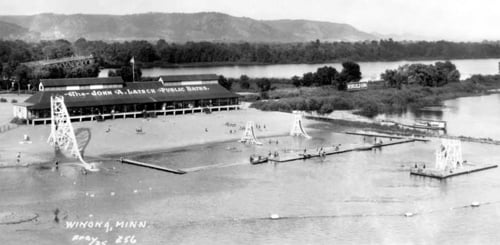
Year after year, John Latsch was saddened at the news of youngsters drowning in the improvised swimming holes arounf Winona. He decided to build the Winona Public Baths on the Mississippi River. (Photo courtesy of the Winona County Historical Society)
It turned out to be the right man to run off a beach in a rainstorm.
The shotgun-wielding farmer watching the bedraggled canoeist paddle disconsolately down the river may have thought he'd simply rid himself of a potentially troublesome vagabond. What he didn't know, couldn't have known, that his vigilante moment would redraw the map of the upper Mississippi near Winona and guarantee wildlife habitat and outdoor recreation for generations.
It wasn't just an ordinary vagabond he'd run off from Camp Glory on the west bank of the Mississippi upstream from Winona.
It was John Latsch, Jr., caught in a sudden rainstorm with his newspapers and jug of buttermilk, unwinding from the stress and concerns that came with running one of the largest grocery wholesale houses in the region. On that long, soggy paddle home, Latsch added a third enthusiasm to doing business and being on the river: buying up and donating for the public good as much of the Mississippi valley as he possibly could.
Before his death in 1934, Latsch bought and donated more than 18,000 acres, including Aghaming Park, Gabrych Park and Westfield Golf Course in Winona; John Latsch State Park and portions of Whitewater State Park in Minnesota; and Trempealeau Mountain, John Latsch Overlook, and portions of Merrick and Perrot state parks in Wisconsin. And he funded the John C. Latsch Public Baths on Latsch Island that provided Winona with safe swimming and recreation for decades.
The example Latsch set had even more far-reaching consequences.
In the early 1920s, confronted by reclamation projects that would have destroyed thousands of acres of prime wildlife habitat along the upper Mississippi, Chicago businessman, outdoor enthusiast and friend of Latsch, Will Dilg, organized 50 wealthy and influential colleagues to lobby for federal action that would preserve and protect habitat for future generations.
As a result of their efforts, in 1924, the Congress authorized the Federal Wildlife and Fish Refuge Act which laid the basis for the federal refuge system that protects thousands of acres of prime habitat across the country.
Year after year, John Latsch was saddened at the news of youngsters drowning in the improvised swimming holes arounf Winona. He decided to build the Winona Public Baths on the Mississippi River. (Photo courtesy of the Winona County Historical Society)