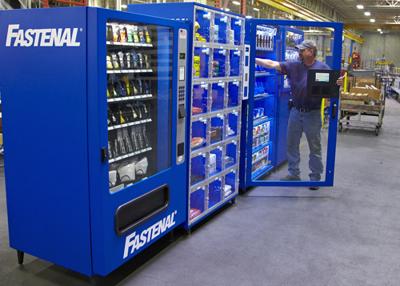

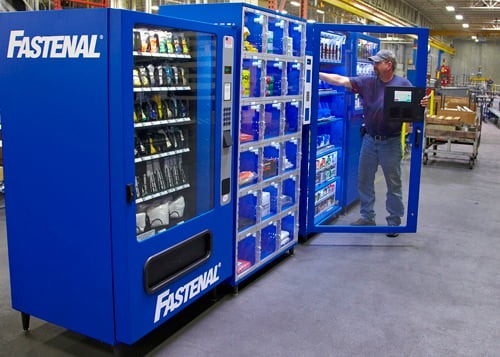
Most industrial and commercial distributors don't have storefronts in more than 2,500 locations across the country. Or large custom-manufacturing divisions to provide parts and solutions they don't carry in their stores. Or a nationwide fleet of 24,000 Internet-connected vending machines offering products to customers around the clock.
Most companies aren't Fastenal.
Founded in 1967 by Bob Kierlin, Fastenal was originally envisioned as a one-stop-shop for nuts, bolts and other parts. The innovations and ideas that have been adopted over the years came from Fastenal sticking to its motto of “Growth through customer service.”
Fastenal chief financial officer Dan Florness said what makes Fastenal unique as a national company is its focus on working with customers locally.
“We've had a storefront approach, a local presence approach from the start,” Florness said. “There might be a national distributor that operates out of four or five locations in the state of Minnesota. There is nobody in our business that has 2,500-plus locations.”
People are also reading…
Fastenal still acts as a one-stop shop for customers looking for nuts, bolts, and other parts it buys from thousands of manufacturers. But by embracing vertical integration it serves the customers on many different fronts.
Fifteen years after it was founded, Fastenal launched its own manufacturing division, offering custom parts, machining and engineering services. It then started opening retail stores to sell a wide variety of raw products, as well as tools and other construction gear.
Most recently, Fastenal began offering customers a new way to get its products: vending machines.
When Kierlin was first thinking about starting Fastenal, he originally saw it as a store like a laundromat, with vending machines that offered neatly packaged containers of parts. But there were two problems, Florness said.
The first was in-demand items in 1967, like rebar and threaded rods, were too bulky to put in a vending machine.
And there was a bigger problem: The technology didn't exist to make the machines feasible.
So the ideas sat on the shelf until 2008, when Fastenal launched its line of FAST Solutions industrial vending machines.
Vending machines aren't new. People have been buying chips and soda from automated machines for decades, and as technology has increased so have the options, from coin-counting machines to automated movie rental boxes.
But Fastenal was able to find new ways to use the concept and improve on it. At the on-site machines, employees swipe their badge to get an item, and the machine’s computer tracks what has been purchased, and by whom. It allows Fastenal to keep the machines stocked, and the companies that use the machines to research ways to bring down materials costs.
The innovations have resulted in consistent growth and profits. In the last quarter, Fastenal reported an 8.8 percent increase in earnings, and sales had grown 4.9 percent. Much of that was fueled by installing more than 4,300 new vending machines and opening 11 new retail stores.
“By being very innovative over the years we have developed a better solution, a better value for our customer,” Florness said. “Because of that, more people buy from us than forty years ago. And each customer spends more with us than they did 40 years ago. And that is how we have grown.”