


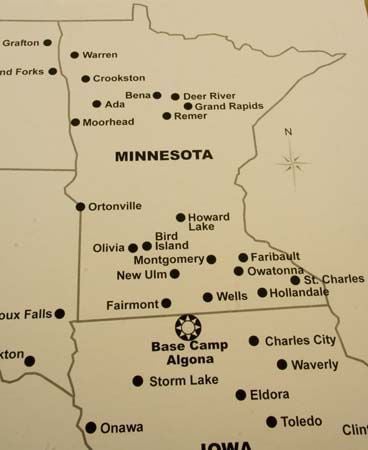

During the summers of 1944 and 1945, the U.S. Army used a former Civilian Conservation Corps campsite in Whitewater State Park to house about 380 German prisoners of war.
Whitewater was one of 34 branches of a prisoner of war camp in Algona, Iowa, where some 10,000 German prisoners spent the final years of the war.
Because so many U.S. workers were either in the service or engaged in the war effort, the POWs were employed by local farmers and food processors, who paid 55 cents an hour for the work. The prisoners received 80 cents a day - in coupons for the camp canteen - and the government kept the rest.
A tornado destroyed most of the camp buildings in 1953, and the park service knocked down the rest to make room for the picnic area, but a few people still remember the days when German soldiers lived in Winona County. Here are two of their stories.
People are also reading…
Former German soldier recalls doing time in Winona County
Sixty years ago on the Sunday before Easter, John Hagemeyer began marching from his home in northwest Germany toward the Western Front.
He never made it.
Within a week, the 19-year-old soldier was taken prisoner by Allied forces. He was shipped to the United States, where he was taken to a prisoner of war camp in Algona, Iowa, before eventually being shipped to a branch camp in Whitewater State Park near St. Charles.
Hagemeyer was one of 426,000 German POWs brought to the U.S., and one of about 380 to stay in the converted Civilian Conservation Corps barracks at Whitewater.
While there, Hagemeyer and his fellow POWs filled in the war-time labor shortage. He worked mostly in a canning factory in Rochester but also spent a few days on a farm in Winona and remembers a "beautiful lunch" that the farmer's wife prepared. (Employers were not supposed to feed the POWs but historical accounts suggest they often did.)
Hagemeyer was trying to pull together the few words of English he had learned in the camp to thank the farmer's wife when she spoke to him in the low German dialect of his native region.
"It was like speaking to a neighbor," he says.
But it wasn't only the farmers who treated the prisoners well.
Work at the canning factory was rough, Hagemeyer says, and the dry bread and baloney sandwiches in the prisoners' sack lunches didn't provide enough fuel. One day the regular workers at the canning factory staged a sit-down strike until they were assured that the POWs would get better food.
"I'll never forget that," Hagemeyer says, "those people sticking up for us."
After the war, Hagemeyer was shipped home, but his train was stopped at the German border and the soldiers spent the winter of 1945-46 in France.
Hagemeyer survived what he calls the "death camp" and eventually made it back to Germany.
A few years later, he and his wife immigrated to Canada, and in 1961 they moved to Seattle, Wash., where he worked as a utility company foreman and later inspector. He became a U.S. citizen and even shook the hand of President Clinton.
Hagemeyer, now 79 and retired, returned in 2003 to the place where he spent the war. The buildings were gone - a tornado hit the camp in the 1950s - but the limestone bluff was unmistakable.
"The rock face was such an imprint on my memory that I felt like I had left there yesterday," he says.
Although life in the POW camp was not easy, Hagemeyer says the prisoners were happy to be alive.
Hagemeyer recently viewed the traveling "Eyes Wide Open" memorial of more than 1,000 pairs of boots in honor of the U.S. troops who have died in Iraq. It was a sobering experience, he says.
As he touched the boots, he thought of how lucky he was to have been captured and to have an extra 60 years of life.
Elba man remembers driving POWs around in an old school bus
Bob Mauer had an unusual summer job for a kid in Elba, Minn. - transporting prisoners of war.
After graduating from high school in 1945, Mauer - who wouldn't turn 18 until October - worked at the Rex Turkey Plant and Elevator in Altura. (The war was over by the time Mauer was drafted, and he ended up serving in Korea.)
For an extra dollar a day, Mauer drove an old school bus up to Whitewater State Park, where he would pick up 15 or 20 German prisoners of war who were housed in a former Civilian Conservation Corps camp site.
The first day when he picked up the prisoners, the camp commander asked Mauer if he needed a gun. Mauer said he had one at home but didn't think he would need it.
The POWs at Whitewater, most of whom were captured near the end of the war, ranged in age from 15 to 50. Mauer remembers most of the men he drove to work each day as being about his age.
Only one of them spoke any English. Mauer, now 77, spoke a little Luxembourgian, a dialect of German, but for the most part communication was limited.
The prisoners weren't fed particularly well - Mauer remembers them bringing sack lunches with peanut butter sandwiches - but local farmers who employed them often supplemented their diets with home-cooked meals.
One day at the turkey processing plant, Mauer said, the owner wanted to reward the prisoners for their hard work, so he went out and bought a few cases of Hamm's beer and a bottle of Seagram's.
As they rode home that evening, the drunk POWs were singing and rocking the bus as Mauer drove down the hill from Altura.
He told the translator to calm the guys down, but to little effect. At the foot of the hill there was an open ditch across the road, so Mauer barreled towards it, threatening not to brake unless the prisoners sat down. The prisoners got the message and at the last minute Mauer slowed.
"Just keep your mouths shut," Mauer told the interpreter as they pulled into the camp.
But just as soon as they got off the bus one of the Germans howled and their cover was blown.
When he showed up the next morning, Mauer said, the guards wouldn't let him pick up the prisoners until the plant owner came out and smoothed things over.
Mauer said the German prisoners were generally well-behaved, but most of them did believe that Germany would eventually win the war.
"They were just like the rest of us, they just got themselves in a bad situation," he says.
Sometimes he would hear them talking and gesturing out the bus windows. When he asked the interpreter what they were saying, he learned that they were picking out the farms that they hoped to get when the war was over.
First published March 20, 2005


