


A crowd gathered quickly at the levee on that memorable Oct. 17, 1911. As the minutes ticked by, men women and children anxiously scanned the sky and talked excitedly about the event to come.
Business houses close that day and school didn’t “keep." Housewives dropped their mops and brooms to troop to the levee – for October 17 was the day Winonana are to see an aeroplane land at their city for the first time in history!
This event could well be called the beginning of the history of aviation in the Winona area.
But there’s another day long ago which could be circled on Winona‘s calendar as the beginning of the history of aviation here.
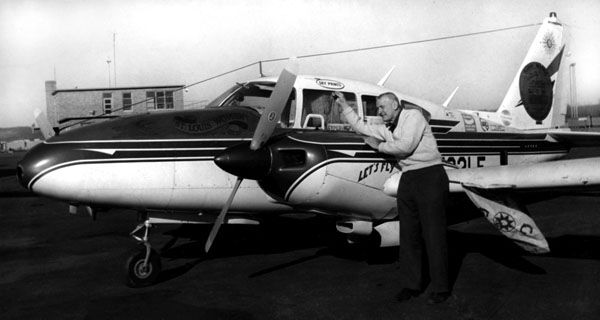
Shift the scene to May 23, 1928. On that spring day a young lanky Winona named Max Conrad Jr. landed his 180-horsepower custom-built plane on the Charles Biesanz farm (now the site of the Sky-View Drive-n Theatre, formerly the old Winona airport and property of the Winona Sand and Gravel Company) and touched off an interest in flying here which has never waned.
People are also reading…
These were the early highlights in aviation and Winona – events which propelled the exciting and dramatic growth of a new mode of transportation in the years after the Wright Brothers Kitty Hawk flight in 1903.
Dissapointment
On October 17, 1911, the crowd that gathered at the levee was doomed to disappointment.
This flight like, like the early balloon ascensions here, was part of a promotion backed by a group of Minneapolis men. They hired pilot Hugh Robinson to fly from Minneapolis to New Orleans to break the record for the longest flight at that time. Funds to finance the flight were raised by subscription from communities all along the way. The Winona Republican-HHerald pledged the $300 necessary to get the flight to stop in Winona.
A special telephone network was set up so news of the progress of the downriver flight could be channeled into the Republican-Herald office. When Robinson reached Minneiska the newspaper was to make the announcement and all the whistles in the city were to blow, business houses were to close, and everyone was to gather on the levee.
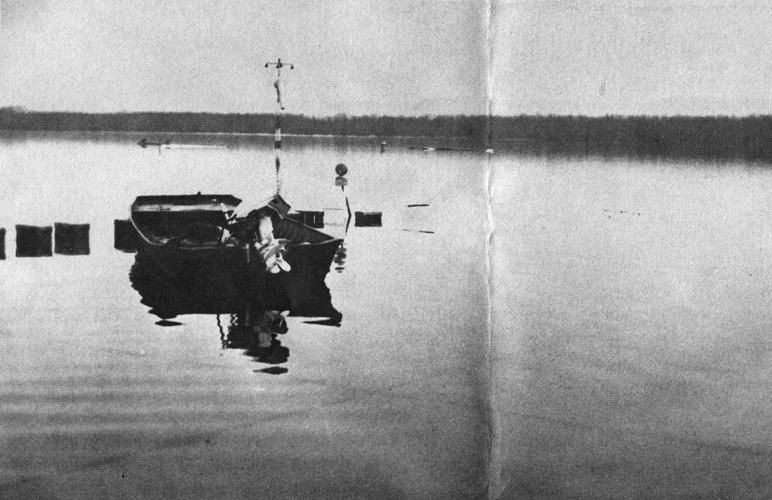
Bad weather and mechanical problems delayed the aeroplane, however, and it failed to show up at noon as scheduled. After the crowd waited until past 3 p.m. word was received that Robinson had run out of gasoline and gone down near the present site of the Whitman dam, on the Wisconsin side.
Several launchs, including E. L. King's, were set out from Winona and towed the plane in.
People lined up on the bridge to watch the eventual take off – days later after extensive repairs were made to the plane – but they were highly disappointed when Robinson took off downstream and kept right on going to La Crosse without putting on the promised exhibition.
A different story
Max Conrad Jr.‘s flight in 1928 is a different story. Its success aroused tremendous interest in flying among the young men of this community and created a new local hero.
The Biesanz pasture where he landed with the “Swallow" grew into the aviation center of all Southeastern Minnesota and Western Wisconsin through Max's effort, and an airport was built on this site. He established the Conrad Flying Service in 1927 as the student training center.
Buildings were constructed at the airport which became municipal in 1941. On Jan. 29, 1943, Conrad's layout at the airport was wiped out by fire. The loss was about $130,000. A new hanger was built later.
Airport dedicated
The biggest event in the history of aviation here was the dedication of the Winona Municipal Airport June 18, 1949
After a huge volunteer effort by Winona civic official‘s, committees, and volunteer groups, Winona acquired a Class III airport with a modern, two-story brick administration building – the best in Minnesota in the opinions of experts. Designers were Carl W. Frank, city engineer, and the city engineering department.
Those who sparked the airport project year after year, making legal negotiations, raising funds and making structural plans were the city council, and the Association of Commerce Industrial Committee and several organizations interested in having a better airport than "a sod field nestling against the bluffs."
Spearheading every major move for a better airport with a late Roy T Patenaude and William Galewski who not only volunteered countless hours of their time, but spend a great deal of their own money in order to raise funds for the project and expedite construction.
Dedication of the Winona airport took place in a two-day celebration June 18, 19th, 1949 -- the biggest event in the city's history. More than 35,000 persons witnessed the dedication and the magnificent air show.
Lieutenant General E. W. Rawlings, comptroller of the Air Force; Senators Edward J. Tye, Hubert H. Humphry, and Congressmen August Andresen were among the many prominent speakers.
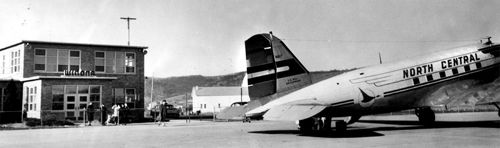
More progress was made in aviation here with the inauguration of commercial airline service in 1952. On May 11, North Central Airlines came into Winona with for flights daily.


