


About the time Hannibal Choate was born April 28, 1835, the New York state community where his parents lived was renamed Carthage, inspiring his father to give his son the name of the great hero of the ancient city of Carthage.
Like his ancient namesake, young Choate soon sought new worlds to conquor. He made his way west to Janesville, Wis., working for a retail establishment. At 24, he left Janesville, but brief period of travel was brought to an abrupt conclusion when he found himself in Mobile, Ala., at the outbreak of the Civil War, putting him at considerable hazard because of his “Yankee” sympathies.
He made his way north, with $900 in his pocket, which he used topurchase the Chapman Bros. store in Winona
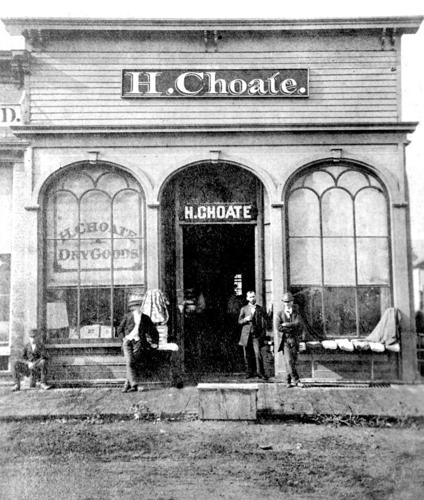
It was on a raw, wintry day in December 1861 that Choate arrived in the village that was to be his home and the scene of his great merchandising triumphs for the next 62 years.
People are also reading…
His first look at the town was not impressive; neither was the town’s first look at him.
Winona was a small steamboat landing, with rutted mud streets, sparsely settled and boasting only a cluster of weathered wooden buildings as its business district.
Choate was 26, travel-stained and tired from his trip, carrying in his hand a large, shabby suitcase tied with rope, and in his mind the ideas that were to make him “The Merchant Prince of Southern Minnesota” within just a few years.
Hannibal Choate was a pioneer of the fixed-price system of merchandising. Previously the price of an item was decided by how shrewdly the customer could bargain for it. At Choate’s, each item was marked with its price and that price was the same to everyone.
He was among the first merchants to use extensive indoor displays of merchandise, hanging them on lines throughout the store rather than keeping them on shelves.
When Choate opened his store at 117 Main St., he stocked it with an enticing variety of groceries, boots and shoes, yard goods, crockery and what have you. “Yankee Notions” were a special feature.
In addition to attending his retail trade, Choate shipped dressed pork and grain to far away markets, including Europe.
So successful was Choate’s store that the walls of the little store would not hold the necessary stock, and part of it had to be moved into the then new Simpson building at Second and Center streets. The Simpson block was the finest in the city at the time, besides being in the most desirable location in town near the levee.
Not only was Choate’s business prosperous during the first year in Winona, but his luck was equally good. Choate’s was virtually the only downtown business untouched by the great fire of 1862.
Choate was innovative but also eccentric. After the fire Choate had a sprinkler system installed – a very modern idea at the time. Once the workmen were done putting the system in, Choate set a fire in the basement to make sure his new investment worked.
In the 1860s, Choate’s advertised as “Choate’s Cheap Cash Store — Terms Cash.”
To help promote his store, Choate put up signs approximately a mile apart on every main road coming into Winona, saying “8 Miles to Choate’s Cheap Cash Store,” “7 Miles to Choate’s, etc.” Choate marked off the miles himself, traveling the roads with his horse and wagon and equipped with a crude odometer.
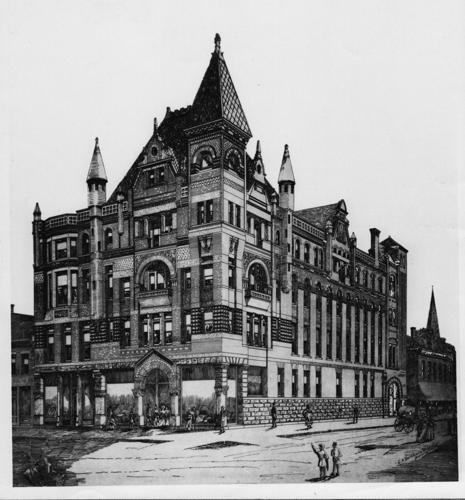
After eight years in the Simpson building, Choate purchased what at one time had been a grain warehouse and former livery stable at Center and Third streets, where the present building now stands. He built a brick store on Center Street just back of the Choate block and while operating a store in this location, built the large stone structure that became one of the most distinctive stores in the new West. This was built in 1888 at a cost of more than $50,000.
Meanwhile, all but dry goods lines were disappearing from Choate’s and the store was plugging the phrase, “We will not be undersold.”
Probably the most gala days in the history of Choate’s began Oct. 12, 1888, with the grand opening of the imposing new store at Center and Third streets. Banner headlines three decks deep in the Winona Republican advertised that a stock valued at $200,000 was featured at the grand opening, offering Winona men, women and children a variety of dry goods seldom seen in one store.
Wholesaling business was gradually tapered off after this as improved railroad transportation and growth of the wholesale houses in Chicago and in the Twin Cities made this business less and less profitable. Around the turn of the century, Choate discontinued wholesaling.
Ready-to-wear clothes began making their appearance too during these years. Many Western stores viewed the trend as a threat to their success and hesitated to go along with the idea. Choate foresaw that this was the future in clothing sales and embraced the idea by adding a ready-to-wear department to his store.
Management of the building passed down through three generations of Choates — from the elder Choate to Hannibal Choate, Jr. and to grandson Charles in the 1920s. Hannibal Choate died May 6, 1923, after a two-week illness.
Jerome Christenson is deputy editor at the Winona Daily News. His phone number is 507-453-3522 -- leave a message if he's not around -- or email at jerome.christenson@winonadailynews.com.


