


Founded less than three years after the City of Winona was incorporated, Winona State University has evolved from the first state normal school into a nationally recognized institution, regarded as one of the United States’ top educational “buys.”
It was community support that helped found WSU shortly after the Minnesota Legislature passed a bill in 1858, establishing normal schools “to prepare teachers for the common (public) schools of the state.”
The Minnesota Normal School Act required that at least $5,000 in money or land be donated for the purposes of a normal school, the state providing $5,000 in matching funds.
The citizens of Winona, led by Dr. John D. Ford, more than met the challenge, raising about $7,000.
Responding to Winona’s quick and generous support, a legislative board agreed in 1859 to establish the first state normal school in Winona, making it the first tax-supported institution west of the Mississippi River dedicated to training teachers for the new frontier.
People are also reading…
The Winona Normal School officially opened for admission on Sept. 2, 1860.
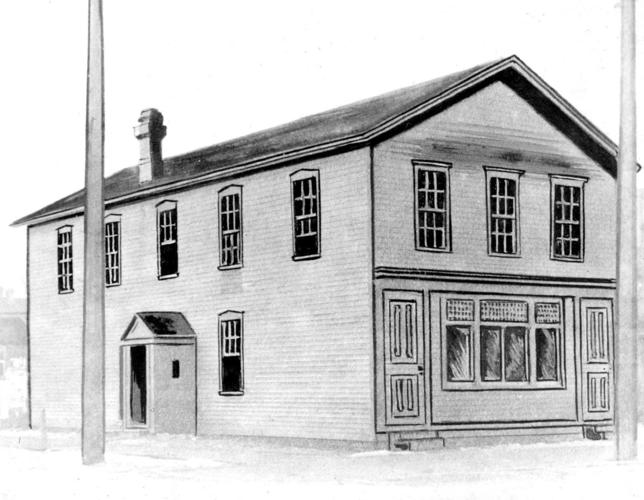
It was first housed in a cityowned building that was loaned to the fledgling educational institution.
In his book, “Winona State University: A History of One Hundred Twenty Five Years,” former university President Robert DuFresne characterized the school’s first 40 years as an era “during which the school struggled just to exist in this rugged pioneer land during the early years of Minnesota’s statehood.”
The state’s first teacher training school was closed from March 1862 until November 1864 due to the Civil War.
As a result of the wartime closing, the school’s first commencement exercises weren’t held until June 28, 1866.
The first graduating class consisted of 10 women and 4 men.
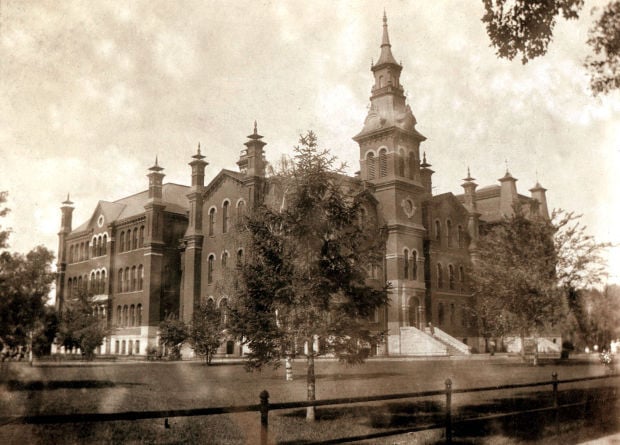
The cornerstone for the first school building, Main Hall, was laid Oct. 19 of that year.
The population of the institution swelled from 61 students in 1860 to 580 in 1899.
Part of the growth was spurred by the growing need for high school teachers in Minnesota.
In addition to the disruption caused by the Civil War, insufficient state funding also challenged the school during its first four decades.
State legislators often responded to budget crunches and revenue shortfalls by trimming support for public education.
Irwin Shepard became the school’s first long-term administrator in 1879, serving for 19 years.
Shepard was the last administrator to be dubbed “principal.” The title was changed to president a few months after Shepard was hired.
Under Shepard’s leadership, the school made significant strides in formalizing teacher education.
Course requirements were steadily increased.
The school also moved away from traditional school mastering and toward a more democratic classroom approach.
The first kindergarten west of the Mississippi was founded at the normal school.
The second major era in the institution’s growth came shortly after the turn of the century when Guy Maxwell became its leader for nearly 40 years.
As DuFresne noted, “At that point it (the school) needed a strong president who would lead it out from its historic confines of normal training to where it could become a regular four-year teachers college with full accreditation and genuine degree offerings.”
Maxwell answered that need, according to historians of the school’s growth.
Under Maxwell’s guidance, the Winona Normal School became the Winona State Normal School in 1905 and Winona State Teachers College in 1921.
The name changes reflected legislative action and the school’s growing importance as part of the state higher education system.
During Maxwell’s reign, high school graduation became an entry requirement, an early form of student government was introduced, the first fouryear degree classes were graduated and the first tuition was charged in 1933.
Prior to that year, students pledged to teach in the public school system for two years to pay the state back $20 each quarter within two years of graduation.
The institution weathered World War I, post-war recessions and the Great Depression.
Private fund raising and generous donations from a growing number of alumni and the community helped the institution to compensate for any shortfalls in state funding.
In the years ahead, private financial support, coupled with taxpayer funding, would help the school to not only survive but to grow.
The school gradually evolved from a teachers college into a full-fledged multi-discipline university during the five decades following Maxwell’s death in 1939.
“Teachers” was finally dropped from the school’s name in 1957, when it became Winona State College.
The name change recognized the expansion of degree programs to include the liberal arts and sciences.
“During this era the institution changed even more dramatically than it did during the Maxwell years, going from the status of a well-established teachers college through that of a rapidly growing state college whose teacher education role was steadily being challenged by the growth of other professional and liberal arts programs, until in 1975, it assumed the title Winona State University,” DuFresne observed in his book.
The first big building boom came during the administrations of Nels Minne, from 1944 to 1967, and DuFresne, from 1967 to 1977.
The most completion’s during that time came in 1964-65, when five new buildings opened: Gildemeister Hall for education and psychology; Watkins Hall for art and industrial education; Lucas Hall for women’s housing, Prentiss Hall for men’s housing; and the first stage of the Kryzko Commons student center.
By the middle of the 1970s, Winona State was organized into three main administrative divisions: arts and sciences, education and graduate study.
The shift in academics was changing to include more emphasis in sciences, business and nursing.
Classes had been held in Rochester beginning in 1917 and expanded greatly during the late 1970s.
The bond with the Rochester community increased as the community college and Winona State built a shared facility in 1987.
The new center allowed students to complete a four-year degree in Rochester.
WSU was once again restructured in 1987, this time into five distinct colleges: health, physical education and recreation, business, nursing and health sciences, science and engineering and liberal arts.
Darrell Krueger, WSU’s present president, took office in 1989.
Krueger worked with faculty, students and staff to forge a common mission statement and goals.
Part of that effort resulted in the development of the Seven Principles of Good Practice in Undergraduate Education.
Under the leadership of Krueger, WSU became a national leader in quality issues and the home of the seven principles.
Street closings, landscaping and other changes were made during the past decade to bind the university’s buildings into a more cohesive campus setting.
The university also began a more formalized approach to long-range planning during Krueger’s administration.
That planning also seeks to strengthen the university’s relationship with the city that helped found the school 14 decades ago.


