


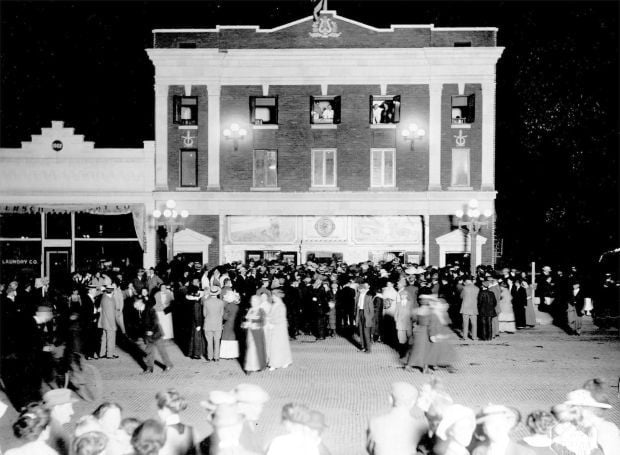
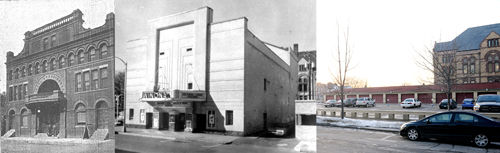
Way back when Anna Held was more famous as a comedienne than as a cigar and her glorifying husband signed himself F. Zigfield, Jr., and while films flickered and were silent, Winona was known as one of the best one night stand theater towns in the country. O. S. Burlingame, manager of the Winona Opera House, was famous for his Burlingame Welch rarebit, his trick telephone and for the then unusual custom of putting clean towels in dressing rooms.
Stars that shone brightly in Paris, London, Berlin and New York occasionally dazzled Winonans in the Gay ‘90s and the first decade of the 20th century and were greeted by full houses, although some of the houses, in theater parlance, were “top-heavy” – from having a disproportionate share of the audience in the gallery.
Winona first-nighters saw and heard such a famous actors and actresses as Julia Marlowe, Richard Mansfield, Mrs. Fiske, William Collier, Cyril Maude, E. H. Sothern, Robert Mantell, DeWolf Hopper, Guy Bates Post, Maxine Elliot, John Drew, Mrs. Leslie Carter, Mary Mannering, William Faversham, Odette Taylor and Walker Whiteside. They saw Edna Wallace Hopper in the curving perfection of the figure necessary for the Floradora girl, and as late as 1905, heard Madame Helen Modjeska, Poland’d for most trajedienne, then 60-years-old.
People are also reading…
Witty Ezra Kendall, first to get $1,000 a week in vaudeville, and Sol Smith Russell, who started at Wausau, Wis., with Mr. Burlingame a stage career that brought the Minneapolis man a fortune, were frequently booked here.
Nat Goodwin had married only a few women when he first came to Winona, and Chauncey Olcott was doing for Ireland’s mothers and colleens what Al Jolson lately did for Dixie's mammies.
There was an intimacy about the theater then that made the great of the theatrical world friends of the manager of the Winona Opera House, and many years after he quit the business Mr. Burlingame received letters recalling parties he gave for the stars of traveling shows at his home.
Robert Taber, Julia Marlow, David Warfield, Charlotte Lambert, Cyril Maude, Chancey Olcott and many others commended Mr. Burlingame on the clean cheerfulness of the theater and Mrs. Burlingame for the hospitable comfort of her home. "Thank you,"wrote one star, "for cheering a lonely working girl in a real home with real people."
Remarking on the change coming about in the theater, Otis Skinner wrote Mr. Burlingame in April 1920: "You are wise to quit the theater end of things. The institution isn't the old delightful one it was when you and I first met. In another year or so I shall be out of it. I've worked very hard and I need the rest and quiet. Good wishes to Mrs. B." Mr. Skinner's first appearance in Winona was in 1893, as leading man for Madame Modjeska.
Mr. Burlingame treasures an unusual collection of autographed pictures of the legitimate theater’s famous people, part of the big gallery which filled the office walls and foyer of the Winona Opera House.
The Winona Opera House had its "flops"as well as its successes, and after one of the former, about 1912, a former world champion and his company went out of Winona “riding on their trunks."
Bob Fitsimmons was a great and popular champion, but the public did not rush to see their favorite in a play to which his main contribution was shoeing a horse. After a succession of poor houses, he and his company left Winona with the railroad company holding the trunks as a guarantee that the fares to the next stop would be paid.
In this day of jazz, talking pictures for every little town, big attendance at sports events and many other forms of entertainment it is hard to realize that 20 or 30 years ago the Winona Opera House was the only place in Winona where public entertainments were given.
At that time there was no other auditorium with adequate stage equipment, and plays presented by the Teachers College, the high school and the College of St. Teresa, and all local and traveling entertainment were given in the opera house.
The idea of chain stores, declares Mr. Burlingame, was originated by theater managers forming what was called circuits in order to book attractions for a solid week or more. Winona was included in a circuit composed of LaCrosse, Winona, Eau Claire, Superior and Duluth, playing attractions one week between Milwaukee and the Twin Cities.
In those days the appearance of a big company was always an event and, as the importance of the attraction was often gauged by the amount of special scenery carried, it was customary to have the transfer wagons pass down Third Street. Sometimes there were as many as six or eight big loads of scenery and properties, and the "parade "always stimulated the sale of tickets.


