
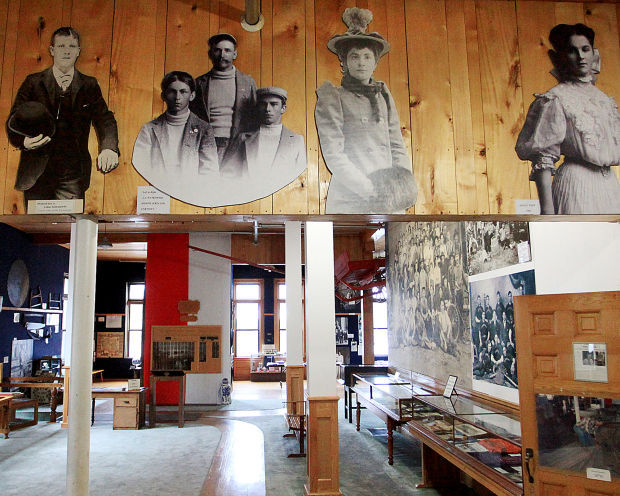
The births, deaths, joys and concerns of Winona’s turn of- the-century Polish community and of Poles across the nation are assembled in a neat, white cabinet in the Polish Museum at 102 Liberty St.
The family of John C. Bambenek donated the most complete collection of the Polish-language newspaper Wiarus known to exist.
The Wiarus, which translates as “veteran fighter for freedom,” was the first Polish-language newspaper west of Chicago and was, “in its peak years the most important Polish newspaper in the United States,” said Anne Pellowski, museum volunteer.
Wiarus was founded in 1886 by Frank Schneider and a group of Winona Poles.
The paper had a rocky start and “wasn’t doing too well” when it was sold to Frank Grygla of Minneapolis on behalf of the man who would bring it to the forefront of Polish culture in America.
People are also reading…
In 1888 Heironim Derdowski arrived in Winona to take over as editor and financial manager of Wiarus.
He was born in 1842 in Wiele, “in the heart of Kaszubian Poland, where many of Winona’s Polish families are from,” Pellowski said.
Derdowski earned a reputation as a journalist, scholar, poet, and patriot in his native land.
“He was a little bit of a revolutionary,” Pellowski said, and had five terms in Prussian prisons to prove it before he took ship for the United States in 1886.
The pastor of St. Stan’s Church, Father Bryzewski, was an old friend, and invited Derdowski to Winona.
Under Derdowski’s guidance, the Wiarus thrived.
His reputation preceded him across the Atlantic and drew subscribers to the Wiarus.
At the time Winona was home to one of the largest Polish immigrant communities in the Midwest.
In 1888, when Derdowski arrived, there were 700 Polish families living in Winona.
In 1905, there were more foreign born Poles, 1,355, living in Winona than in any city in Minnesota.
The Wiarus was an eight-page weekly that carried the news of the world and nation along with news of Winona’s Polish community.
International stories tended to focus, as might be expected, on events in Poland and central Europe, and national stories reflect the interests of the American Polish community, Pellowski said.
“It carried a modest amount of advertising, but not that much,” Pellowski said, pointing to an ad from Winona’s Interstate Grocers in the Dec. 22, 1918, issue on display at the museum.
The page of local news carried by the paper is of particular interest to local historians and genealogists.
The paper carried briefs on who had been hospitalized, who had arrived from Poland, along with marriages, births, deaths and other happenings, such as the notice asking for local women to assist in sewing for the newly formed Polish army that appears in the display issue.
“These are things you never find covered in the (Winona) Republican Herald,” Pellowski said.
“What was going on in the Polish community just wasn’t considered in the ‘society’ news.”
The paper continued to thrive under the direction of several Winona businessmen after Derdowski died in 1902.
The paper continued publication in Winona until 1924 when it was moved to Steven’s Point,Wisconsin.
John C. Bambenek, born in 1891, was a great supporter of the Polish press, Pellowski said.
He was a grandson of Martin Bambenek, one of the city’s early Polish residents, she said.
John C. Bambenek served as Winona County Treasurer from 1922 to 1947.
In 1946 he founded Hiawatha Wood Products with his son James, and brother-inlaw Fred Rettkowski.
He died in 1966.
The family preserved a nearly complete set of the Wiarus that had been in storage at St. Stan’s church, Pellowski said.
Those copies were microfilmed by the Minnesota Historical Society and returned to the Polish Museum.
John Bambenek made a further unique contribution to preserving Winona’s Polish heritage.
In the early months of the Second World War, on hearing that the sons and daughters of Winona Poles serving in the armed forces were having a hard time keeping up with news from home and the location of their friends and neighbors in uniform, Pellowski said.
To fill that need, from 1942 through 1945 he mailed out a monthly newsletter to every soldier, sailor, airman and marine of Polish descent that chronicled the fortunes of the Polish National Alliance baseball team, listed local bowling scores, fishing reports for the Mississippi river and the names and addresses of their friends and neighbors in the service.
“He was a remarkable man and we owe him a great deal,” Pellowski said.