
With 13 thriving flour mills, Winona County held great stature in the grain market at its peak in the industry during the late 1800s.
Winona once stood strong as the fourth most important grain market in the United States, just behind Milwaukee, Chicago and Toledo, Ohio.
In its early days, Winona was perfectly poised to gain its powerful status in the flour-milling industry.
Southeastern Minnesota provided excellent farmland for growing wheat.
And Winona’s prime location on the Mississippi River made it the best marketplace available for farmers.
Winona’s only competition came from small milling operations in towns such as Chatfield and Stockton.
But those smaller operations couldn’t beat the prices offered by larger Winona businesses.
People are also reading…
When the rail connections to Chicago and Minneapolis opened in 1872, Winona’s market grew even stronger.
This opened up more of Minnesota as grain markets for the Winona flour mills.
Another important factor in Winona’s success was the creation of local grain elevators that stored the wheat before shipment.
Initially, these elevators were owned by the railroads, but then flour mills in Winona and other cities took them over.
To compete in trade nationally, every large mill in Winona joined in developing the “line,” a series of grain elevators in towns that stretched into the Dakotas.
Winona’s first flour mill, Goff’s Mill, was established in 1856.
The city’s earliest flour mill was started before market conditions were favorable, however, and the struggle to keep the business operating ended when the mill burned in 1863.
By 1874 the marketplace proved more ready, and other flour mills began to be successfully established in Winona.
By then the city had transformed into a large primary market for grain.
In addition, what was known as the “new process” method of milling began.
This process was undertaken by one of the most important mills in Winona’s history, the Mowbray and Porter Mill, later organized as the L.C. Porter Co.
One of the owners, A.G. Mowbray, was influential in the flour trade as the developer of the “new process,” through which white flour (called “patent”) was ground into bread.
The mills in Winona ground many grades of flour; most of the products were patent, the highest grade.
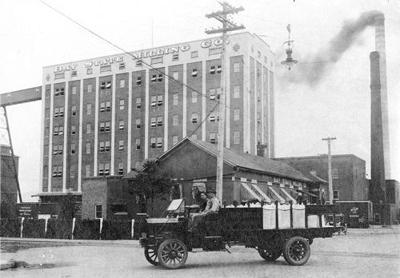
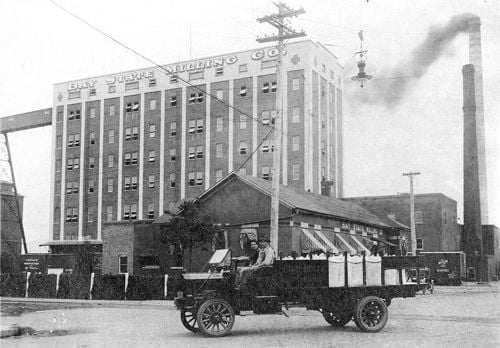
Along with the Mowbray and Porter Mill, other prominent mills in the city were the Winona Milling Co. and the Bay State Milling Co. Founded in 1899, Bay State Milling is the only mill in Winona today.
The company is still owned and operated by the Rothwells, the family that established the mill.
Headquartered in Boston, Bay State Milling is the sixth-largest flour producing company in the United States, with mills located in Florida, New Jersey, North Carolina, Texas and Arizona.
Producing 2.6 million pounds of flour every day, Bay State Milling is the 12th-largest individual flour mill in the country.
The operation runs 24 hours a day and employs about 100 people.
Though Bay State Milling remains a successful enterprise, a variety of factors contributed to the closing of Winona’s other once thriving four milling operations.
In 1890, the Winona Milling Co. plant burned.
The operation’s leaders decided the future for local milling didn’t look bright, so they didn’t rebuild.
Later, the L.C. Porter Mill closed in about 1896.
Changes in the state’s agricultural landscape were a factor in these closings.
The amount of farmland used to grow wheat peaked in the late 1870s and then declined significantly by 1890.
This was caused by low prices, as well as by technological and scientific advances that affected the techniques of production.
Young enterprising farmers also began moving to western Minnesota or the Dakotas to expand the amount of land they could cultivate for wheat.
While the expanding railroad systems initially contributed to the success of Winona’s flour milling industry, they eventually caused a decline in the market.
The railroad created conditions that moved the grain-marketing center to Minneapolis.
The Twin City markets, as well as the Duluth area, could offer a better price than the smaller Winona markets.
The Winona mills faced a distinct disadvantage: Mills in Minneapolis had waterpower to run them; Duluth millers had access to a cheap supply of coal.
Winona mills were dependent on sawmills for sawdust and waste products, which fluctuated in prices.
The grain trade had once contributed significantly to Winona’s early prosperity and then, with the exception of Bay State Milling, faded from the local scene by the early 1900s.