


The shores of Lake Winona were a children’s play area when Chief Wapasha and his village of Keoxah was settled here and has served the same purpose ever since.
As early as the days of Orrin Smith, people began to realize the importance of preserving the parks surrounding the lake, and by the early 1900s several large-scale projects were already under way.
One of the first tasks was to secure the land in the park area. Although a plan to acquire the property was completed in March of 1900 and condemnation proceedings begun in 1901, the $10,000 bond that was needed to pay owners wasn’t approved until June 1906. It took another year until it was announced on July 27, 1907, that all the condemned land had been purchased and that the remainder of the property had either been donated or bought by the Board of Park Commissioners.
During this same time, private contributions towards developing Lake Park began to pour in, eventually totaling over $100,000. After the $10,000 bond had been approved, Matthew G. Norton and William H. Laird donated an extra $10,000 to cover preliminary work and surveys made by O.C. Simonds & Co. of Chicago. The plans called for dredging, landscaping, and additional structures such as a bandshell and lake pavilion.
People are also reading…
The Winona Park and Drive Improvement Association responded by adding in another $20,000, and in 1909 Norton and Laird donated another $50,000 to fill the park, which was mainly marsh.
The Park Board continued to improve the park over the next decade for less than $5,000 annually.
In 1922, new curbing and pavement was contracted with Schruth-Welsch Co. for $21,300.
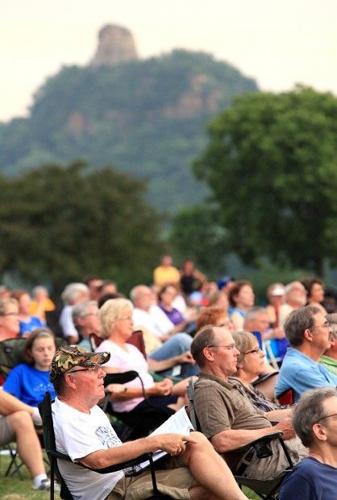
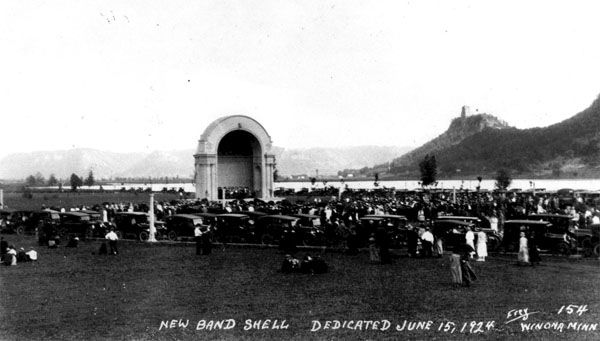
A massive bandshell was donated to the city on June 15, 1924, by Frederick Somers Bell, and lakeside concerts became a telltale sign of summer over the years. In the midst of World War II, it was also the site of a performance by the famous “Who’s on First?” comedy team Abbot and Costello, who were in Winona to sell war bonds.
It took less than two generations for Winonans to turn the mosquito-infested swamp area into a thriving and beautiful social center.
In winter months, the icedover lake provided an excellent arena for skating, and a warming house was soon added. The Winter Carnival drew crowds annually with its snow and ice cen-tered competitions, and the
Winona Trotting club raced horses over the ice before the automobile came into existence.
In warmer months, Lake Winona became a favorite for canoeing and fishing. The midsummer “Chinese Magic Lantern Parade” was a nighttime festival for kids, who marched around the bandshell with paper lanterns lit with candles. Flaming batons were twirled, and the Municipal Band played, but the annual event ended in the 1930s.
The C.A. Rohrer Rose Garden was donated on the eastern end of the lake in 1961 by a local dentist, Dr. Clay Rohrer, and the Winona Rose Society. Within 10 years what had started out as 50 rose bushes had grown to more than 1,000 and was visited by more than 20,000 tourists a year.
Despite the serenity of Lake Park, its origins as a marsh continue to show. Its position on the lake’s edge and high water table caused the fill to become saturated and sink, causing areas near the bandshell to be covered with water deep enough for ducks to make their homes in, often for months at a time. Between the 1980s and ’90s, the park sank nearly five feet and needs to be re-filled regularly.
Although swimmers have replaced trips to the beach with the Aquatic Center and boaters often prefer the river over the wake-free lake, the park continues to be a favorite in Winona.
The city’s Municipal Band still gives free weekly concerts at the bandshell, baseball and softball fields are home to dozens of adult and little league teams, and the Rose Garden has become a popular wedding spot. A path around the lake draws both exercisers and people out for a leisurely stroll daily, and Veterans Park, a memorial to those who gave their lives in the Civil War, World War I, World War II, Korean War, Vietnam War and other wars, honors veterans at regularly held memorial services.
This story was first published Aug. 19, 2001.
Jerome Christenson is deputy editor at the Winona Daily News, which means he does just about anything that needs doing whenever somebody needs to do it. You'll see his name attached to a regular column, historical features, news stories and other accounts of odd happenings around town and around the area. His phone number is 507-453-3522 -- leave a message if he's not around -- or email at jerome.christenson@winonadailynews.com.


