
To Winona’s early settlers, the Mississippi was both a broad highway and a formidable barrier.
While steamboats traveling up and down the river brought settlers and supplies, that same river stood between the growing settlement and the farms and markets in the Wisconsin hinterland.
Crossing the river was a haphazard affair.
Travelers had to find someone with a boat willing to carry them to the far shore.
With no easy, reliable means of crossing, commerce across the river was sporadic until the river froze in the fall.
It wasn’t long before Winona merchants resolved to lay claim to the markets across the river.
In 1855 and again in 1857, the Minnesota Territorial Legislature granted Winona businessmen the right to establish a ferry between Winona and Wisconsin, but in both cases, capital ran short and no boat was launched.
People are also reading…
Expecting a population to boom on both sides of the river in the years after the Civil War, Capt. Samuel Van Gorder of Winona saw an opportunity in carrying man and beast across the Mississippi.
Van Gorder’s ferry was chartered by the State of Wisconsin, and on May 20, 1865 he launched the Turtle.
The Turtle, named, local wags insisted, in recogition of its pace, was built on two hulls with the paddlewheel mounted between them.
This arrangement gave the paddle wheel a degree of protection from debris and floating ice.
Seventy feet long, displacing 30 tons the boat cost $3,000 to build and could carry four teams and wagons on a crossing.
Fares were set at $1.25 for team, wagon and driver, 60 cents for a single horse and carriage, 25 cents a head for horses, cattle or mules or passengers afoot.
Sheep and hogs were ferried at a nickel apiece and goods were carried for a dime a hundredweight.
The ferry ran from the foot of Center St. in Winona to “the stone house” about two miles up river, because the marshy bottomlands directly across the river from Winona were impassable to travelers.
The first year’s operation was less than auspicious.
Van Gorder carried no more than a dozen teams Seeing the need for a more direct route from shore to shore, Col. A. DeGraff, with backing from the city of Winona, set out to build a road across the swamps, sloughs, and rivulets that lay between Winona and solid ground in Wisconsin.
The challenge was greater than DeGraff anticipated, and the project quickly doubled in cost, to the consternation of the businessmen underwriting the effort.
But in 1868, the new road, with a barn to shelter replacement teams, was key in convincing the Burbank Stage line to establish its river crossing at Winona The Wisconsin road, subject to repeated flooding and washouts, proved to be a source of constant expense and aggravation for Winona Van Gorder sold the Turtle and rights to operate the ferry to the city of Winona in 1880.
Two years later the city voted to rebuild the Wisconsin road and five bridges at a cost of $30,000.
The ferry struggled to keep up with the ever-growing traffic.
With fifteen to twenty teams a day waiting to cross, plus other passengers and livestock, either the ferry had to go faster or the trip had to be made shorter.
The city opted for the second option.
In 1886 construction began on a wooden bridge between Latsch Island and the Wisconsin shore.
The old paddlewheel ferry would be replaced by a new boat — a cable ferry that was winched across the channel between the island and the Center Street landing.
While faster and more efficient than the old boat, the ferry couldn’t keep up with the demands of a growing population.
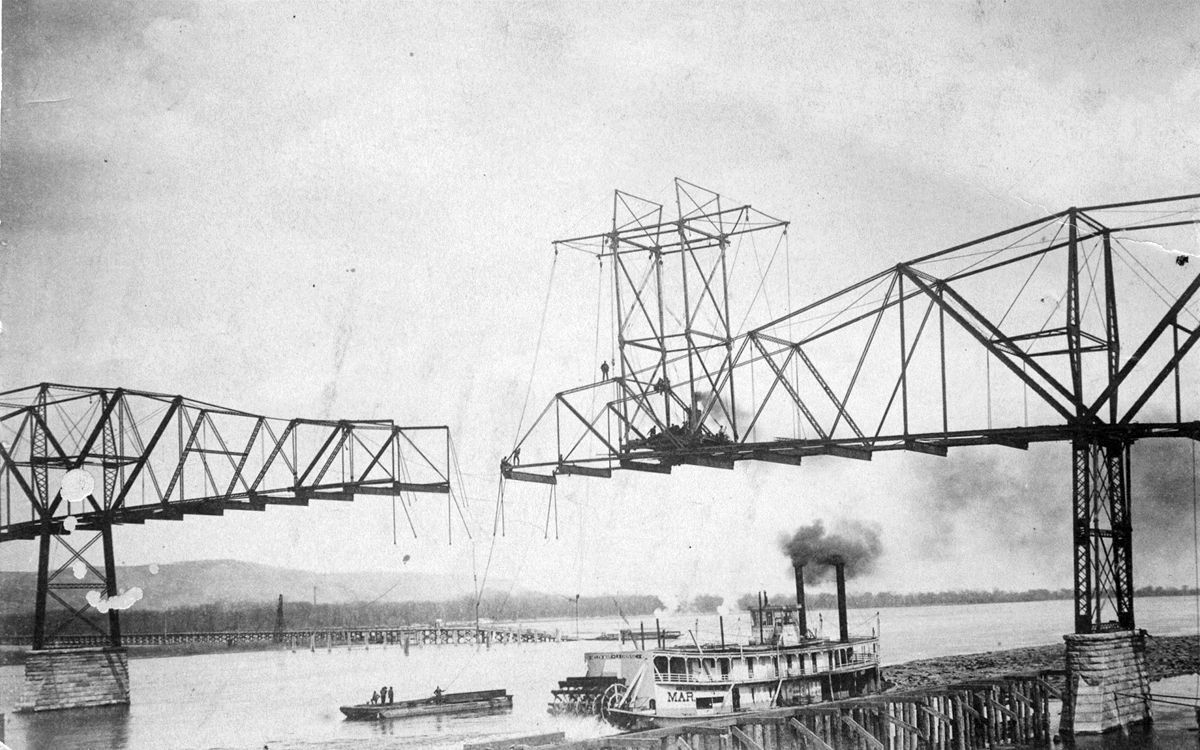
In 1890, Congress granted the city of Winona the authority to build a wagon bridge across the main channel of the Mississippi.
The cost of construction and maintenance would be paid by tolls collected on all travelers, man, woman and beast.
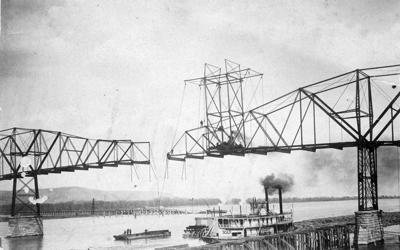
On June 18, 1892, Pat Minck drove his team over the newly completed iron span, officially inaugurating the Winona High Wagon Bridge.
The bridge approach was at the foot of Main Street with a 90 degree turn followed by a block long climb to a second 90 degree turn onto the high span at Johnson Street.
The bridge crossed the channel from the foot of Johnson Street, to Latsch Island then connected with the old trestle bridge to Wisconsin.
In 1912, the Winona city engineer pronounced the old Wisconsin trestle “in poor condition” and recommended its replacement.
Two years later, the city council voted to construct a concrete arch bridge across the river’s north channel to replace the old timber bridge.
Designed by Louis P. Wolff of St. Paul, the concrete span featured twelve 72 foot arched spans.
On the island, the approach to the main channel bridge was too unstable to support a continuation of the concrete bridge, so a lighter steel span was built then covered in concrete to match the appearance of the rest of the bridge.
The new bridge opened in 1917.
According to the Winona Republican Herald, “The new structure from Latsch Island to the Wisconsin side of the Mississippi River has greatly improved traveling over the river and is appreciated by the Wisconsin farmers.
There is hardly a day passes that Mr. Meyer does not receiver some compliment in regard to the marked improvement.
The lights on the new approach way have been connected and for the past three nights have been sending out glowing rays to the passerby.” In 1923, the last bridge tolls were collected and the toll house was consigned to a public bonfire.
In that same year, ownership of the bridge passed from the city to the state of Minnesota when the bridge and its approaches became part of Minnesota State Aid Road Number 19 in 1923.
On the Wisconsin side, the old dike road, built and paid for by Winona taxes and private contributions, became part of Wisconsin Trunk Highway No. 25.
In 1935, 135 foot long section of the high bridge at La Crosse — similar in age and design to Winona’s High Wagon Bridge — collapsed sending two motorists plunging to their deaths.
With the crossing at La Crosse closed and traffic diverted to Winona, many in this city felt the High Wagon Bridge was a disaster waiting to happen.
By 1938, federal authorization for a new bridge across the Mississippi at Winona had been secured.
Construction of the new Interstate Bridge began in 1940 and was completed in 1942.
No sooner was the new bridge in place than demolition crews went to work on the old steel bridge, salvaging the metal for the war effort.
The old concrete bridge was left standing, it’s demolition delayed until the end of the war.
But in 1945, the city petitioned the state to regain ownership of the bridge to provide access to Aghaming Park on the Wisconsin side of the river.
Fifty years later, the bridge had deteriorated to the point where it was closed to vehicular traffic.
A fund drive is underway by the city and private backers to raise the estimated $2,000,000 needed to restore the bridge and return it to service.