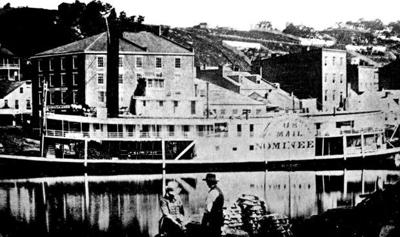


Few things made by man have been better fit for their task than a Mississippi River steamboat.
Fast, cheap, reasonably safe and able to navigate in waters that amounted to little more than a heavy dew, steamboats brought commerce, settlers and a reasonable likeness of civilization to the American wilderness in the decades before the Civil War.
Every schoolboy knows that Robert Fulton invented the first practical steamboat in 1807. That boat worked fine in the deep water of the lower Hudson, but on the wild sandbar-ridden shallows of the great rivers that coursed through the heart of the continent, Fulton's deep-draft design would have needed a flood to float.
The riverboat that conquered the Ohio and the Mississippi was the brainchild of Capt. Henry Miller Shreve, a riverman born and bred on the banks of the Monongahela. By 1816, years of experience muscling keelboats and flatboats taught Shreve a thing or two about what made a boat float on an American river.
People are also reading…
The hull was broad and shallow, curved at the bow and stern -- the broad, shallow hull sliding over the water rather than plowing through it it. Instead of setting the engine low in the hold, the boilers and engines were mounted horizontally on deck, above the waterline, and a two-story superstructure was built over and around them.
Not only did the design prove remarkably fitted to its environment was a commercial success. Shreve's boat, the Washington, made the round-trip from Louisville, Ky., to New Orleans in only 41 days.
That basic design was polished and refined. Captains and investors realized early on that every pound they saved in building the boat meant another pound of paying cargo it could carry. Boats were built to be fast, not to last which was just as well because the average life of a Mississippi steamboat was somewhat less than five years.
Hazards on the river were just about endless: rocks and rapids, sand bars, snags, low-hanging trees and unpredictable currents. Boats that weren't sunk, beached or battered still could burn or blow up.
The high-pressure steam engine driving the paddle wheel was the wonder of the age, but as often as not it was built with no safety valves or gauges to keep track of steam pressure or water level. If the water level in the boiler dropped too low, the boiler would overheat, weaken and explode with disastrous results. On April 27, 1865, a boiler aboard the Sultana exploded, killing more than 1,700 passengers and crew more than went down with the Titanic.
Despite the dangers, the steamboat was the frontier equivalent of the 747. The steamboat fed a frontier boom, carrying settlers and manufactured goods from the east, then taking back the products of the opening west -- lead, grain, furs, flour, salt, meat and cotton.
The number of boats on the rivers boomed. Fourteen years after Shreves first trip to New Orleans, 230 steamboats were working on Midwestern rivers; by 1842, there would be 450. The Virginia, in May 1823, was the first boat to pick its way onto the upper Mississippi from St. Louis for Fort Snelling, Minn. It took 26 days to make the 729-mile trip.
Within two years of the Virginias first visit to Pigs Eye and the Falls of St. Anthony, more than a quarter-million dollars worth of frontier goods furs, hides, lumber and grain were shipped downriver. Several boats were making regular calls at Prairie du Chien, La Crosse and points north.
As the population along the upper river grew, more and more specialized boats were built to serve the burgeoning market. Boats were engineered for maneuverability and designed to float on less than 2 feet of water. Steamboats carried passengers and cargo on streams that would bar a contemporary fishing boat. Early boatmen probed local streams and rivers as well, operating regular service up the Chippewa to Eau Claire and navigating the Root River as far as Rushford.
But war and invention eventually would end the steamboat era.
Secession and civil war closed the river as conquest and occupation of the lower river became a primary strategic goal for Union forces. The great port of New Orleans was blockaded and occupied for the duration.
With the river trade at a halt, railroads had incentive to expand. North-south trade along the river was supplanted by east-west rail routes .
Steam power on the river would never recover. Specialized work boats for hauling barges and maneuvering log and lumber rafts were developed and elegant excursion boats returned to the river, but the work-a-day handling of travelers and freight became a rail monopoly. Boats working the upper river would all but disappear until the shipping industry was revitalized by the construction of the lock and dam system, creation of the 9-foot channel and advent of the diesel towboat.
The 9-foot channel stands Henry Shreves principal he built a boat to fit the river on its head by rebuilding the river to fit the boats. Time might prove Shreve had it right the first time.