


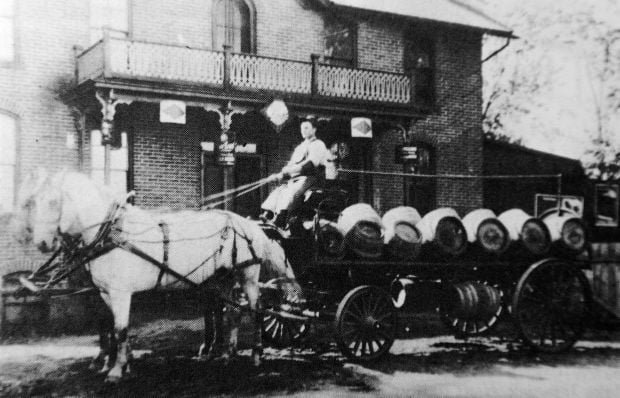
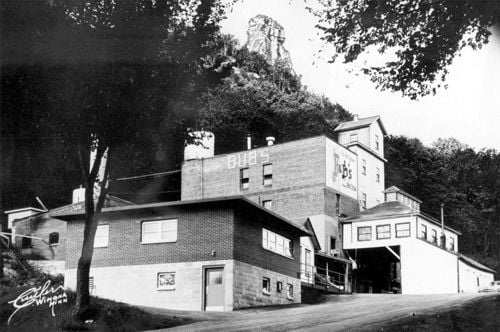
Look closely and there’s still remnants of the brewing industry that once flourished in Winona.
The building that now houses Sugar Loaf Furniture once bubbled over with recently brewed beer.
And Bub’s Brewing Co., the bar/restaurant at 65 E. Fourth St., boasts a few artifacts from its namesake brewery, Peter Bub Brewing Inc., Winona’s longest running and best-known brewery.
Perhaps one of the best places to celebrate Winona’s long-standing tradition of brewing is in a place called Wellington’s, the only business remaining where Winona brewed beer can still be found.
“I do actually feel myself a part of the brewery tradition in Winona, for sure,” said the microbrewery’s brewmaster Chad Peters, who has been running the brewery/restaurant since March 2000, when founder Chris Gardener left.
People are also reading…
Peters can’t say for sure why the alcoholic beverage has remained so popular.
“Personally, I think beer is good,” he said. “But it’s an odd drink.”
Wellington’s brews about 60 barrels of beer a week, he said, and Minnesota law forbids Wellington’s from selling its product off the premises.
But Wellington’s beer is popular with the regulars, some of whom live in the Twin Cities and stop by when they’re in the area just to sample the brew, Peters said.
“We are a little brewery, but we participate in a couple different festivals each year,” he said. “We are known.”
Wellington’s represents a brewing history that is almost as old as Winona itself.
In the fall of 1856, when Jacob Weisbrod’s original brewery began operating in East Burns Valley, the territorial village of Montezuma had recently changed its name to Winona, a county jail made of logs was still under construction and the current topic of conversation concerned plans for the forthcoming draft of a state constitution.
But increased demand required a larger plant in the shadow of what is now Sugar Loaf, although even that landmark didn’t appear as it does now.
O’Dea Quarries had yet to give Sugar Loaf its unique shape.
Beer was brewed for the first time in the new plant in April 1862, and Peter Bub signed on in 1869 as the brewmaster and foreman of the Sugar Loaf plant.
After Weisbrod died in 1870 and Bub married Weisbrod’s widow in 1871, Bub became the brewery’s manager.
When the Sugar Loaf Brewery burned to the ground early the following year, Bub chose to continue the business, building a bigger, stronger facility and giving it the name most people recognize — Peter Bub’s Sugar Loaf Brewery.
The post-fire era saw a steady expansion of brewery operations, and the original cellar soon became too small.
Construction and expansion at that time saw the brewery multiply its output capacity by more than 20 times, from an output of about 500 barrels annually to well over 10,000 barrels.
Eventually the brewery produced 30,000 barrels a year.
Bub’s wasn’t Winona’s sole brewery, although it was the most prominent and successful.
In the opening years of the 20th century, Park Brewery opened along the river, in what is now Godfather’s, producing
Sunshine beer and Park Malt Tonic.
Schellhas Brewing Co., formerly Becker and Schellhas, produced Gold Meal, Old Private Stock and Pale Bohemian.
Improvements in roads helped these breweries transport their product and therefore flourish, but January 1920 dealt a huge blow — Prohibition.
Park and Schellhas didn’t survive.
But Bub’s made it through the 13-year drought by switching production to soft drinks and alcohol-free beer.
The fact that Prohibition was unpopular — and, in many ways, a dismal failure — helped Bub’s cause, said Carlos Walter, Bub’s last manager.
People began spiking alcohol-free beer, and Prohibition was repealed in April 1933.
From 1933 to 1944, Bub’s produced German-style beer, but World War II made this taboo, and Bub’s switched to American.
Bub’s rolled successfully along through the 1940s and 1950s, but the end was nearing.
Walter and his wife had no one to take over the business, and it was getting increasingly difficult to compete with the big-time beer producers.
“TV really started the ball rolling downhill,” Walter said.
Large companies bought advertisements Bub’s couldn’t afford.
Three blows during the 1960s spelled the end for Bub’s.
First, Congress voted against legislation that would have given tax help to smaller breweries.
In 1965, nearby Fountain Brewery closed, and the market was flooded with breweries cashing in on the “open market,” offering deals Bub’s couldn’t match.
Those factors, combined with new Occupational Safety and Health Administration standards that would have cost Bub’s between $150,000 to $200,000, led Walter to the decision to sell the brewery.
In 1969, with no one to take over, Walter and his wife put Bub’s stock up for sale, and the 107-year-old legacy of Bub’s closed forever.


