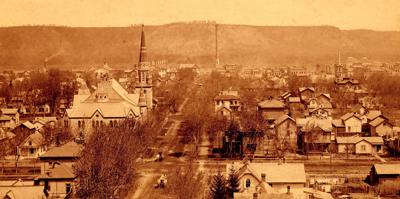

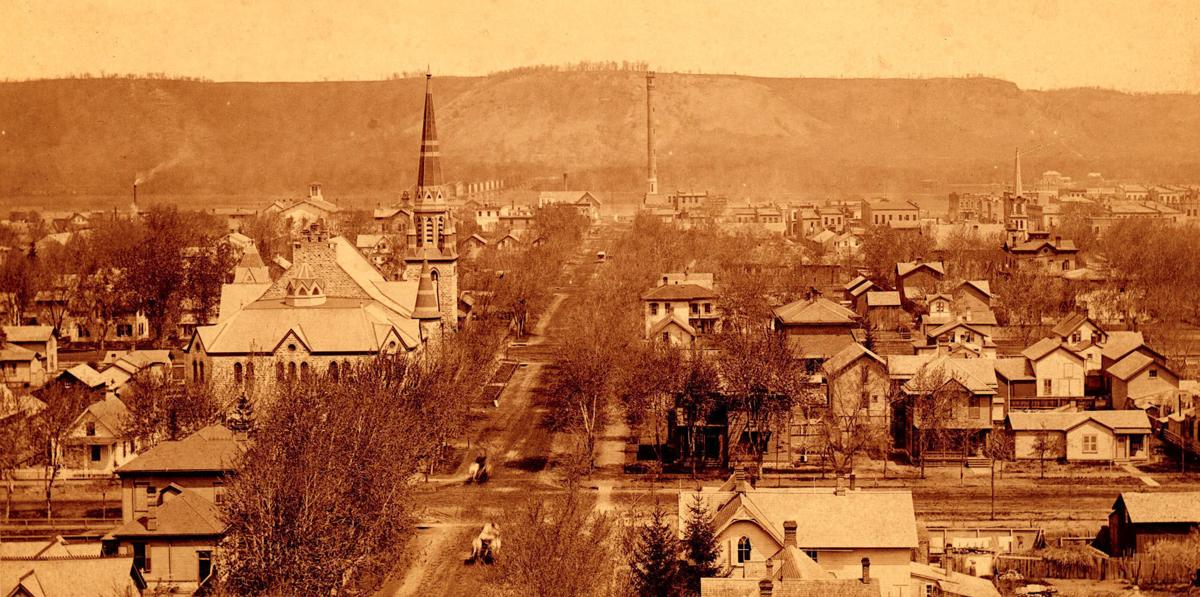
The story of how Winona streets received their names is an interesting one.
For instance, Edward Elder Ely, the first postmaster, is credited with naming Center and Lafayette streets.
It was something that Ely was proud to tell about.
He said he once met Gen.
Lafayette, the French patriot who aided Americans in the Revolutionary War.
The meeting occurred while Ely was a boy, and on that meeting was based the naming of one Winona street.
It was Mrs. Abner S. Goddard who christened Walnut street.
The boarding house of “Aunt Catherine,” as she was familiarly known, was home for many of the first settlers of the struggling prairie settlement.
Not only was it home, but during the year of 1852, when the little village was visited by an epidemic, it also did duty as a hospital for many of the afflicted.
People are also reading…
Her husband and one of her two children were victims of the disease.
The Rev. Hamilton
Hamilton Street bears the name of Rev. Hiram S. Hamilton, a Wabasha Prairie pioneer, of 1852.
He was not only the first pastor of the Congregational church, but in that same capacity guided the destinies of the first church organization in Southern Minnesota.
History points out that Mr. Hamilton obtained possession of the so-called Nash claim through the scheming of his son Charles.
Chatfield Street now serves as a monument to Judge Andrew Gould Chatfield, associate justice of the supreme court of Minnesota territory, during the years from 1853 to 1857.
The village of Chatfield also is named in honor of the judge.
Steuben Street, according to the records, came by its name second hand in a way.
The name honors Baron Von Steuben, of Revolutionary Fame.
But in reality it received the name from Steuben County, New York, the early home of three pioneers—Gen. Charles H. Berry, Judge Chauncey N.Waterman and “Grandpa,” P.P. Hubbell.
Peter Bauder, proprietor of the old Bauder House, situated at what is now the southeast corner of Washington and Second streets, but long since destroyed by fire, desired to honor his wife.
As a result we now have Louisa Street, that being the name of this better half.
The historian facetiously remarks that Broadway and Main streets came to their names naturally, adding that Broadway particularly was well named.
It is said the pioneer settler to whose sagacity and enterprise the city of Winona owes more than to any other is Henry D. Huff.
It seems fitting therefore, that streets of the city today should honor not only his memory, but also that of his wife and son.
Thus it is said that we have Huff, named for him; Harriet, named for his wife; and Wilson, for his son, Wilson Creek Huff.
One of the men who played an important part in the early history of Minnesota while it still was a territory was David Olmstead.
He served as president of the first territorial legislative assembly.
With his brother, he had come to Wabasha Prairie in the fall of 1852.
They had made the long journey from Fort Atkinson, Iowa, on foot.
In the spring of 1853 he decided to locate in St. Paul where he served as the first mayor of that city.
He returned to Winona in 1855, remaining here until 1857, when he returned to Vermont where he died.
Olmstead Street and Olmsted County both honor his name.
Wabasha Street takes its name from the Wabasha Indian chiefs, who roamed this territory in the early days.
Johnson Street, one of the principal thoroughfares, takes its name from Erwin Johnson, who has the distinction of being Winona’s first settler.
The first general store in Wabasha Prairie was opened by George H. Sanborn and W.H. Colborn.
In 1856 he erected a three-story building on the river front at the foot of what is now Washington Street.
This was known as Sanborn’s warehouse.
The upper floor was fitted with a stage and scenery by the old Philharmonic Society.
It is in his honor that Sanborn Street was named.
He also platted Sanborn’s Addition.
One of the show places during the early days was the beautiful home of Dr.William S. King, a pioneer of 1855.
It occupied the site where Morey Hall now stands.
Later it was used as a dwelling by Bent Langley.
It has since been moved and now stands at 311 W. Wabasha St.
History does not state whether it was a sense of gratitude that was responsible for the name of Mark and Howard streets, but one is tempted to believe that such was the case.
At any rate it was Mark Howard, a resident of Hartford, Conn., who paid the sum of $66.66 for a third interest in the Edward Hamilton claim, now known as Huff’s Addition.
Mr. Hamilton at the time considered he had made a good sale, we are told.
The two above streets honor the eastern gentleman.
John Street is thought to have been named for John Evans, whose early claim was in the vicinity of that street.
Allen Gilmore, first settler of Gilmore Valley, is said to be responsible for the naming of Gilmore Avenue.
Sioux and Dacota streets both derive their designations from the great federation of Indian tribes, which for centuries considered the Mississippi River the eastern outposts of their domain.
Another Indian name is that of Winona Street, named after the first born Sioux maiden, “Wenonah.” Hilbert street, we are told, takes its name from N.F. Hilbert.
During the seventies he served as cashier of the Merchant’s National Bank and later as county surveyor.
Judge Ozro Barnes Gould, who served as district judge during years of 1895 to 1897, is honored in the naming of Gould street.
He had a notable war record and is credited largely with being instrumental in obtaining the establishing of the Soldiers’ Orphan’s Home in Winona.
A combination of circumstances was instrumental in the naming of Orrin, Wayne, Clark and William streets.
History sets forth that three brothers, Orrin, Wayne and George Clark, all early pioneers, reached Winona on Nov. 12, 1851, having walked across the state of Wisconsin.
It is said that George Clark, when laying out the Clark and Johnson Addition, employed one William Maceman to assist him.
As a reward Clark jokingly promised Maceman to name one of the streets in his honor.
This promise was kept in the naming of William Street.
Maceman Street, strangely enough, was not named for him, but for Bernard Maceman, a pioneer gardener.
Two shipmates who turned “landlubbers,” after sailing before the mast for five years, came to Winona and entered the shoe business together and they also platted the Cummings and Vila additions.
To complete the close friendship they both married sisters. The two men were I. B. Cummings, and W.K.F. Vila, for whom Cummings and Vila streets, respectively, are named.
Baker and North Baker streets are named for Benjamin Baker, who bought, moved, remodeled and sold old houses in the west of the city.
He also platted the Baker and Balcom additions.
From the Winona Daily News Centennial Edition, Nov. 20, 1955.