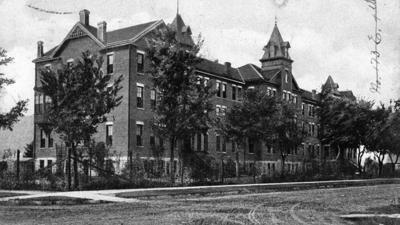

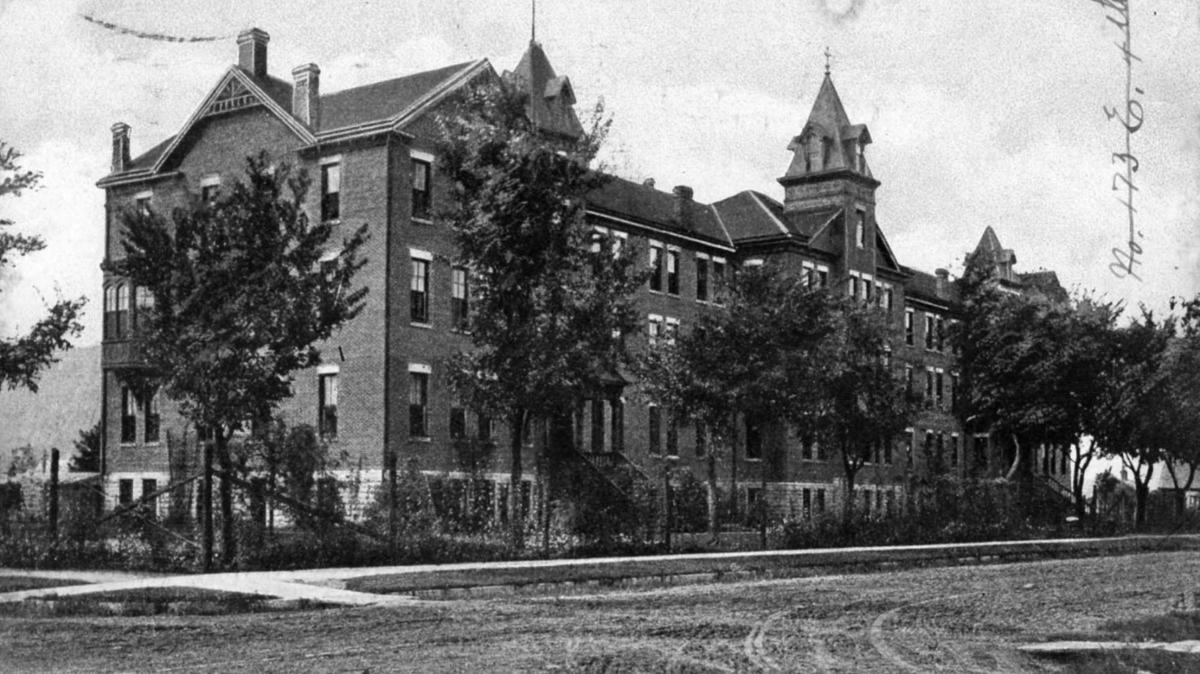
Sisters Leo Tracy and Dominic Mahl came to Winona in 1894 to found a college--with$4.28, a horse and a mortgage.
In the years 1860 to 1900, close to 300 colleges and universities sprang up across the United States. Some of these were state-sponsored public universities, but many were founded by the Catholic Church.
For the Sisters of Saint Francis, the fledgling city of Winona seemed a likely prospect. In 1884, Mother Alexia Hoell of Milwaukee bought 11 acres along Wabasha Street and immediately began construction of St. Mary Hall. In December 1885 St. Mary’s Academy, a girl’s boarding school, opened. The Academy was never able to support itself, and after two years of constant financial strain, the school closed and was sold to Archbishop Joseph Ireland for a $29,000 mortgage.
The building switched functions during the summer of 1888 when the Sisters of St Joseph from St. Paul established a hospital. Winona proved to be too healthy for the facility, and business shut down several years later.
People are also reading…
In 1894 the building was sold again for $29,000, this time to Rochester’s Academy of Our Lady of Lourdes and the Sisters of Saint Francis. Sister Leo and Sister Dominic arrived in Winona later that year with their horse, Jim. Sister Leo had $3.53 in her pocket, Sister Dominic a whopping 75 cents. They shared a new mortgage, and there were expensive renovations to make, but the Winona Seminary opened yet that September to 59 students.
During the first year, $15 a month covered tuition, room and board, lessons, and instructions in needlepoint. Students were taught to act and dress in a manner of simple elegance, and the Sisters proclaimed that the work of the seminary was to give an education that would produce young women of the highest culture.
The inaugural year was a defiant success after the previous line of failed ventures, and the school began to flourish. The second year boasted an enrollment of 86 students, and it continued to increase every year.
By 1903 the academic department had expanded to include classes in science, English and classics. Departments in art and expression, physical culture, and household economy had been added, as well as a music conservatory. The school had enjoyed such success that its leaders were able to make the last payment on the mortgage by 1905.
In 1907 the seminary extended an invitation to Mary A. Molloy, the first woman to graduate from Cornell University, to come to Winona and help prepare the Franciscan sisters to instruct on a college lever. The same afternoon she received another invitation to study Gaelic in Ireland, but when September rolled around she packed her bags for Winona and after only one year with the school was made assistant principle.
The coming years brought the complete transformation from a girl’s boarding school to a women’s college. In 1911, Molloy assumed the role of the school’s first dean and Sister Leo, now known as Mother Leo, became the school’s first president in time to award the school’s first bachelor of arts degree. In 1912, Bishop Patrick Heffron, who at the time was busy making plans for his own men’s college, asked Molloy and the sisters what they planned on naming their new school. The name “St. Mary’s” had seemed like a natural choice since most of the college lay in St. Mary’s Hall, but Heffron was set on having the name for his school. The sisters next considered naming the school in honor of Teresa of Avila, and the name “College of Saint Teresa” was formally adopted. Also that year the halls of St. Teresa and St. Cecilia were finished and dedicated.
The campus continued to expand over the next decade. In 1920, a nursing program was added, and Lourdes Hall, Alverna Hall, and the basilica-style St. Mary of the Angels Chapel were built. Molloy joined the order of her peers and became a Franciscan nun under the name of Sister Aloysius, and in 1928 she was named the school’s second president. 1928 also brought the debut of an education program.
Sister Aloysius continued her presidency until 1946. She died in 1954. The College of Saint Teresa was formally accredited by the National Council for Accreditation of Teacher Education. Enrollment continued to rise between 1965 and 1967, at one point reaching a peak of 1,350 students. The Mary A. Molloy library was opened in 1967, but the golden days were coming to an end for St. Teresa’s.
In the wake of Vatican II, thousands of nuns left their orders. The loss of the religious oreder on the college faculty required hiring lay professors at considerably higher salaries than required by sisters vowed to poverty. Enrollment declined as the prospect of four yeas of college without men had a diminished appeal for a tgeneration on the front lines of the sexual revolution. . As the 1980s came around, people began to speculate that the floundering all-women college had fallen behind the times. In 1986 the school responded by officially allowing men, but it was too little, too late. A merger with Saint Mary’s College also failed. In 1988 the college announced that it was facing its last year. In the spring of 1989, the last commencement ceremony was held on St. Mike’s field.
This story first appeared Aug. 19, 2001.