


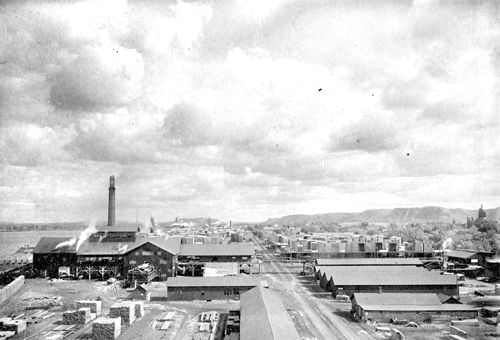
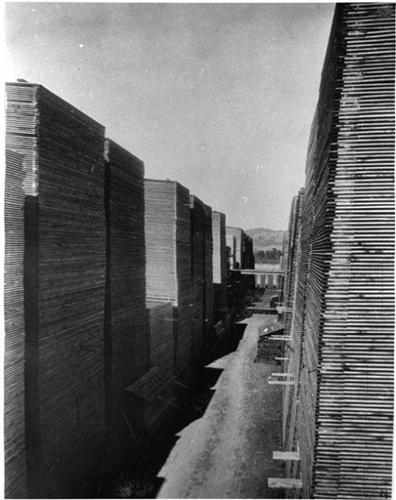
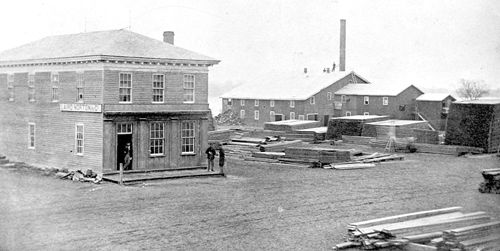
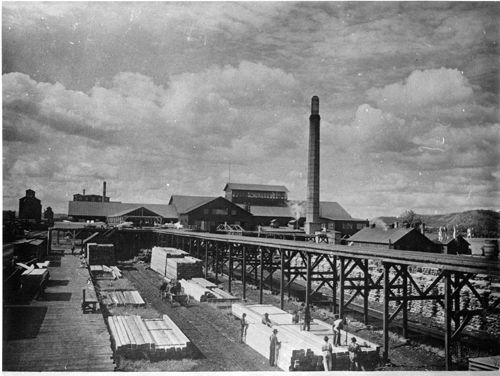
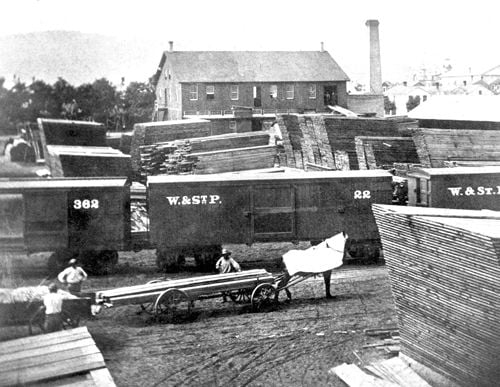
At about 5 o’clock Friday morning, June 24, 1887, the worst fire ever experienced in the lumber district of Winona broke out in the large saw mill of the Laird, Norton Co., and in a few minutes the whole structure was in ruins. The Winona Republican described the early morning disaster and its aftermath:
The destruction of the large sawmill of the Laird, Norton Co. by fire this morning, involving a direct loss of $100,000, is a calamity such as the city has not before experienced for over 20 years.
Fortunately, though the blow is a very serious one, both in its direct and indirect results, it is not overwhelming, and there can be no doubt that the energetic and enterprising gentlemen whose valuable mill has just been reduced to ashes will speedily replace it with one still better and more substantial. In the meantime one of the worst features of the occurrence is the stoppage of the company’s manufactures at the busiest time of the year, and the consequent throwing out of employment of a large number of men.
People are also reading…
About 200 men will be thrown out of employment. One of the firm’s representatives remarked to a representative of the Republican: “I feel very sorry to have our men thrown out of work. Some of them felt so bad they had tears in their eyes.”
The mill was originally built in 1857, enlarged and rebuilt in 1878. It was one of the largest and best equipped mills in the Mississippi River valley. In general terms, it had two gangs, a rotary and a band saw, a 12 block rotating shingle mill, and one hand shingle mill, lath mill. Power was furnished by two large engines. Its capacity in round numbers was up to 200,000 feet of lumber a day. Average daily cut was 175,000 feet besides 150,000 shingles and 50,000 lath. The mill was valued at $100,000. The insurance was $30,500. The disaster came in the midst of the busy sawing season.
A fisherman named Martin Fellke, with his partner, who was putting in a line on the opposite side of the river about half past four o’clock looked across and seeing a red glare in the north window of the mill, remarked to his partner that the sun was coming up. Not long afterward he saw the smoke issuing and then heard the alarm.
The foreman, Mr. Jas. McConnon, lives near the mill and was just going to his barn when he heard the whistle blow. He looked toward the mill and saw the flames already bursting through the roof.
Mr. Grimes, the inside watchman, had taken a tour of the mill only a short time before the alarm was given, but saw no sign of fire. The cook on the company’s steamer Glenmont, which lay at the wharf, passed by the mill at 5 o’clock. He spoke to the watchman Grimes at the engine room and also had a few words with the outside watchman, Mr. Nelson, who was standing on the north end of the mill. He passed on to the boat and in about five minutes heard the alarm.
He ran out and saw flames bursting out from the mill.
The watchman Nelson first saw smoke issuing from the upper floor of the mill. He ran into the engine room and with the other watchman started with the hose through the large iron door leading to the mill, but they no sooner opened it than they discovered that the whole lower floor was ablaze. The flames seemed to burst out from all parts of the mill at once and made such rapid headway that the appliances in the engine room for extinguishing the fires could not be used.
They were driven back to the engine room and had barely time to blow the alarm whistle twice before the flames drove them out of there, too.
The general alarm that went up from the mills brought the firemen and a crowd of citizens quickly to the scene. Fortunately there was little wind, but the heat was intense.
The fire crept along the tramways leading across Front street and to the eastern and western portions of the yard, but the firemen fought it back, successfully shielding themselves as best they could with doors and other protections, but in most cases standing up to their duty regardless of personal comfort.
Four or five box cars standing on Front street caught fire and were badly burned, but were prevented from being entirely consumed.
On all sides the firemen did effective ser- vice. Seven or eight streams from the city waterworks were playing, being mainly directed to prevent to spreading of the fire. Engineer Barns was running the fire pump in the planing mill for all it was worth, and the hose companies consisting of the employees were directing their efforts to wetting down the exposed sheds and lumber piles. Chief Haley and the other officers of the fire department disposed the men to good advantage and fought the fire at every available point. Mayor Matthews was early on the ground and worked shoulder to shoulder with the firemen in their brave efforts.
When the tall iron chimney fell, it struck on corner of the blacksmith shop, but did no more damage to than to take off a small part of the roof. Something seemed to give way at the same time. There was a report, and a column of steam shot up into the air, presenting a spectacle similar to that of a volcano.
Great pieces of sheet iron roofing were carried up a hundred feet. For the instant the air was filled with debris. There was a scattering of people to places of shelter and as the loud noise of steam blowing off kept up, the crowd was apparently timid and disposed to keep at a safe distance. No one, however, was hurt.
A large piece of roofing came down within a foot or tow of Ed McConnon, who was carrying a door to protect the hosemen. James L. Norton and M.G. Norton were early on the ground, quiet and cool as usual, directing the efforts to keep the fire with in the limits of the mill and cautioning the bystanders against danger from approach- ing too near some of the standing pipes and timbers.
William H. Laird did not hear the alarm until a few minutes before six. The mill had fallen in when he reached there. Like the other proprietors, he was disposed to look upon the favorable features of the disaster in that the absence of any wind prevented the fire from consuming any more of their property or extending to their neighbors. The office on the west, the large storage sheds across the track to the south and the piles of lumber on the east were untouched by this fiery element. The log slide on the north side was partially burned, and the burning edgings in the dock along the boom compelled a pretty obstinate fight for some time.
The firemen left the fire about 1 o’clock this afternoon, but the men of the Laird, Norton hose company played upon the fire more or less all day.
Engineer John Gerlicher, who has been in the employ of the Laird, Norton Co. nine years, was working hard today clearing the rubbish from his engine room, which had been one of the finest in the northwest. When reference was made to the loss, tears stood in his eyes, and he said he felt almost as bad as though he had lost a child. Mr. Gerlicher lost about $3,000 worth of tools in the fire.
It is now thought most probable that the fire originated in the saw filing room in the third floor at the north end of the mill. On the evening before at 5 o’clock the filer was welding a bandsaw and had in use a portable furnace. He says he was careful to wet down everything after he got through, so as to leave all safe.
In thirty years experience in making lumber, this is the worst catastrophe the Laird Norton Co. has sustained. About 1869 or 1870 there was an explosion of the boiler in their saw mill and two or three years ago one of their dry kilns burned.
It is the most extensive loss that has ever visited the lumber district of Winona. Real- izing the magnitude of their business and the danger from fire, the lumbermen have always been very vigilant and have taken every possible precaution to guard against fire, but this subtle destroyer will often baf- fle the keenest vigilances.


