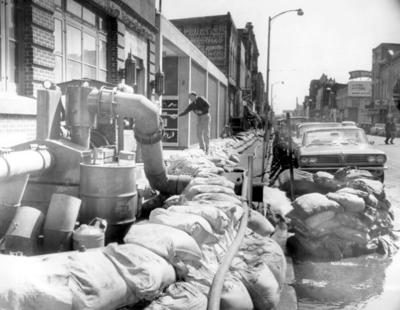

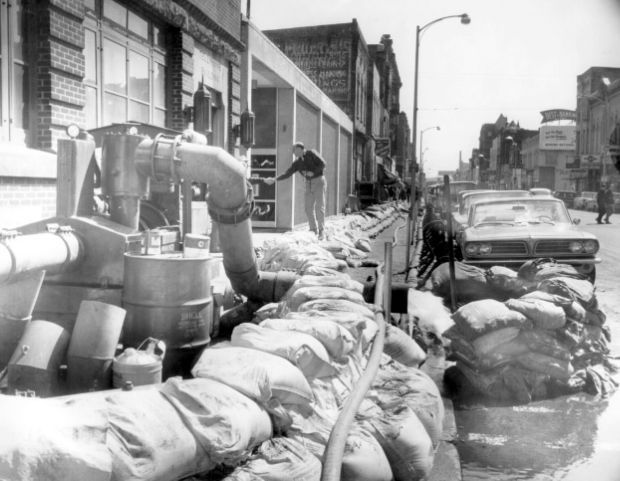
The water was coming.
In 1965, the winter snows fell heavy, piling up on the plains and in the northern forests. March brought more snow, followed by icy rain and melting.
Across Minnesota and Wisconsin, streams began to swell, and rivers rose, setting the stage for a spring flood that would wash away records throughout the Midwest.
Along the Mississippi River, there was time for a warning. A Mississippi flood builds not in hours, but in days and weeks.
In early April, the Minnesota River burst its banks at Mankato, sending thousands to higher ground.
In Winona, residents and city officials knew the water flowing through the streets of Mankato was on a one-way course to their own backyards and basements, unless they moved quickly to stop it.
People are also reading…
On April 9, Mayor Rudy Ellings called a morning meeting of the city council and department heads.
By now the flood forecasters were warning that the coming water would surpass the 17.94-foot record set in 1952 by at least a foot.
The old dikes, left over from the 1952 deluge, would form the basis for the city’s defense system, but the rebuilt dikes would have to be significantly higher and stronger to turn back the power of a record flood.
The city moved swiftly to mobilize men and machines.
Within two days 200 men had been hired at $1.50 an hour to fill sandbags and fight the flood.
Winona public schools superintendent A.L. Nelson urged all city high school students 16 years old and older to sign up for flood duty, adding that any who were called to defend the dikes would be excused from classes for the duration.
Within days across the city 100 trucks, 25 bulldozers, 10 draglines, 15 front-end loaders, four earth movers and 500 men were at work piling earth, sand and rock from Dam 5A at the far end of Prairie Island to the far side of Shives Road on the city’s east side.
Fill was extracted from pits on the city’s east and west sides.
Materials were stockpiled, including 450,000 burlap sandbags and 40,000 feet of polyethylene sheeting used to face the dikes to seal them from the infiltrating flood waters.
By the 12th, the flood crest had moved off the tributaries and into the Mississippi near the Twin Cities, and forecasters were projecting 21 feet at Winona, nearly three feet above the 1952 record.
To the north, Wabasha faced a unique threat.
The ice on Lake Pepin — 30 inches thick and still solid — was floating on the rising river. “We can fight high water, but there’s no defense against a moving ice field,” Wabasha game warden Willis Kruger said.
In Winona, people began to prepare for the worst.
In a low-lying area along West Third, Fourth and Fifth streets, an area that was underwater in 1952 when the Crooked Slough dike gave way, people began packing up and moving out. Rudy and Clara Schnieder — Rudy’s fishing boat tied to the back porch “just in case” — moved their belongings out of 657 W. Fourth, fleeing the third flood since they moved in.
A string of freight cars loaded with rock stood on the Chicago and Northwestern tracks, ready to be pulled out onto the bridge as the waters rose to weight it down and keep it from floating away.
Civil Defense Director George McGuire looked at the effort and pronounced it good.
“Everything has been doing real well. Progress has been swell!”
An unidentified dike worker, veteran of more than one flood, offered a less cheery assessment. When they finish with this round of temporary dikes, he opined, “they should pour concrete over them and leave them there.”
On the 15th, as the river continued to rise, President Johnson flew into St. Paul.
In a cold rain, accompanied by congressmen, senators and Gov. Karl Rolvaag, LBJ spent 16 minutes looking at the river, declared the government would do everything it could to help, got back on Air Force One and disappeared into the clouds.
At the Cargill elevator in Savage, sandbaggers ran out of sand and substituted wheat in a desperate attempt to patch a cracking dike.
The experiment was a success: Wetted down, the wheat swelled, sealing the cracks more tightly than sand.
In Winona, Northwestern Bell finished hoisting its equipment well above the level of the anticipated crest.
A spokesman commented, “If the water rises high enough to put this equipment out of commission, no one will be left in Winona anyway, so telephone service will not be needed.”
As the water moved past 16 feet, Mayor Ellings declared a state of emergency in the city.
The local commander of the Corps of Engineers recommended lighting the dikes and warned that 1,500 dike workers would be needed to shore up the city’s defenses.
Floodwaters over the tracks between Winona and the Twin Cities brought rail traffic to a halt.
“Nights are quiet in Winona,” a writer noted in the Daily News, “There are no towboat whistles. There are no train whistles.Without the fast passenger trains and heavy freights moving through the city, it almost seems like Rochester.”
On Lake Pepin, the ice, still a solid sheet 2 feet thick, a mile wide and nearly 30 miles long, had begun to move.
“If Lake Pepin ice comes in with the floods, there will be no Wabasha,” mayor Ray Young said.
The next day, Pepin was ice free and Wabasha was still standing. Flowing against a strong north wind, the ice broke up and dissipated before reaching the city.
In Winona, they chopped holes in the hull of the Julius C.Wilkie to keep the steamboat-turned museum from floating away on the coming crest.
On Good Friday the city was tested. As a concession to the extremity of the situation, Bishop Edward Fitzgerald granted all Catholic floodworkers special dispensation from the required Friday abstinence from meat.
As the Johnson Street river gauge crept past 19 feet, a boil erupted at the base of the dike near Olmstead Street.
A fast response stemmed the flow, but Ellings ordered a secondary dike thrown up along West Fifth Street, ordering the people living between Wilson and John streets on the river side of the dike — Rudy and Clara Schneider among them — to abandon their homes.
In low-lying neighborhoods across town, moving companies and anyone with a truck and spare time hauled sofas, bedsteads and other personal belongings to higher ground.
The Red Cross began setting up emergency shelters and published advisories as to what well-prepared refugees should bring along when fleeing their homes and what to leave behind.
Firearms, the Red Cross warned, would be confiscated.
Out on the dikes, volunteers “dressed like they were going waterskiing in the dead of winter” patroled the dikes, walking the tops of the sodden structures in two-, three- or four-man teams.
The city now had more than a million burlap sandbags on hand or on order. Purchased at 13½ cents apiece, they would bring only 3½ apiece if they were returned unused. “I’d rather have 100,000 too many than 10,000 too few,” Ellings said.
Local businesses joined individual volunteers in doing what they could to aid the fight, altruism that in at least one case led to misunderstanding.
The Peter Bub Brewing Co. published a notice informing the public, “The Bub’s kegs you see our personnel delivering to dike workers are filled with pure, clean drinking water.”
When the faithful gathered for afternoon services, one pastor couldn’t resist telling his flock how he was planning to build a boat to ride out the flood — 300 cubits long, 50 cubits wide, 30 cubits high.
Then, at about 7 p.m. Good Friday, a dike broke. On the Wisconsin side of the river.
The Burlington Northern right of way washed out near Bluff Siding, sending millions of gallons flooding the bottomlands.
In the marshy areas, water rose as fast as a man could walk, Buffalo County Sheriff John Marsolik reported.
“The water would keep right up with you.”
The river still rose, but more slowly.
On Monday the river at Winona reached 20.75 feet, and began to recede, but the crisis was not over.
Unable to come over the dike, the river threatened to invade from below. Water backing up in the city storm sewers was pushing into the city.
In a move of desperate ingenuity, divers squeezed into manholes to stop up the sewers with heavy-duty inflatable rubber bags.
Like corks in a bottle, they held.
The river continued to fall.
Warily, Winona dared itself to relax. At the height of the crisis, more than 5,000 people — 20 percent of the city’s population — were helping fight the flood.
“There is not a single instance where a project was held up for lack of manpower,” said Ray Brown, manpower director.
A week later, on April 27, dike patrols were discontinued.
Two days later the dike along Fifth Street was dismantled.
When Rudy and Clara Schneider moved back to their home on Fourth Street it was dry as the day they moved out.
The water had been stopped.