


The announcement 80 years ago was a case of "a rose by any other name."
On March 19, 1921, the Winona Normal School became Winona State Teachers College, a boost in status with no increase in funding or facilities.
Since its doors opened in 1860, the "oldest teacher training institution west of the Mississippi" faced a hardscrabble existence. Normal schools survived on meager budgets and Spartan facilities.
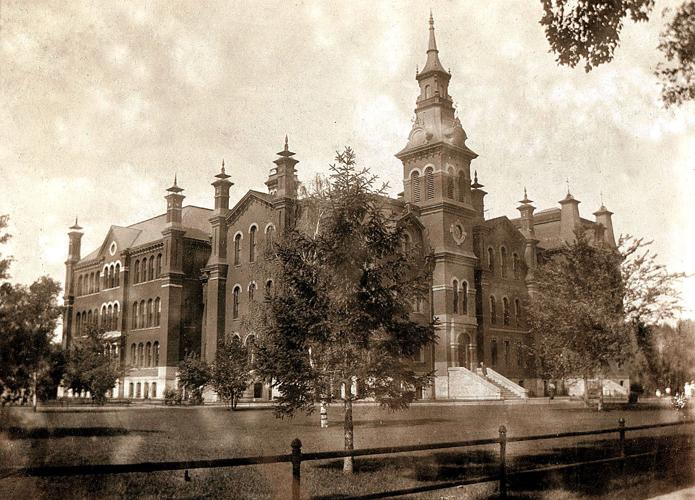
It was no surprise then, that the cornerstone for the main aca demic building on the Winona campus had been laid the year after Civil War ended, although it took three years for the build ing to be completed. The building stood between Sanborn and King streets, with Main and Washing ton streets on the east and west, three stories high, U-shaped with a heating plant in the cen ter added in 1907. Immediately to the east was the college library and women's gym, built in 1909. On the west, Phelps Model School had been completed in 1918.
People are also reading…
The old building was considered adequate by the state and was expected to serve the needs of the newly designated teachers' college well into the future. No one had considered how the school would fare without it.
The campus was especially quiet when the custodian locked up at 6 p.m. Saturday, Dec. 2, 1922. Most staff and students had been gone, as the fall term ended Wednesday. With the heat ing plant shut down, the building would be vacant until winter term opened with 9 a.m. chapel on Monday.
It was the end of a quiet night when police captain J.J. McCaffrey walked by the dark, silent building on his way home at 5:15 a.m. Sunday.
Fifteen minutes later, from his home at 127 W. King, G.A. Hess saw a flickering light in a base ment window of the building across the street and hurried to telephone the fire department.
Ladder trucks pulling up in front of his home at 171 W. King roused F. C. Peterson from his bed and sent him to investigate the fuss.
"The fire, at that time, seemed insignificant," Peterson told the Winona Republican-Herald.
"I was about to go back home when suddenly there was an explosion which shattered the windows and flames seemed to be everywhere," Peterson said.
"I beat a hasty retreat, not knowing what was going to happen. I hurried back to my home to put on more clothes, and just as I got to the door, there was a tremendous explosion, and I saw a round hole blown in the wall at the west entrance to the building. The hole in the wall was big enough to drive a truck through."
"The fire spread rapidly after the explosions," Peterson said. "It was only a short time before the whole east wing and central section of the building were in flames. The west wing took fire last."
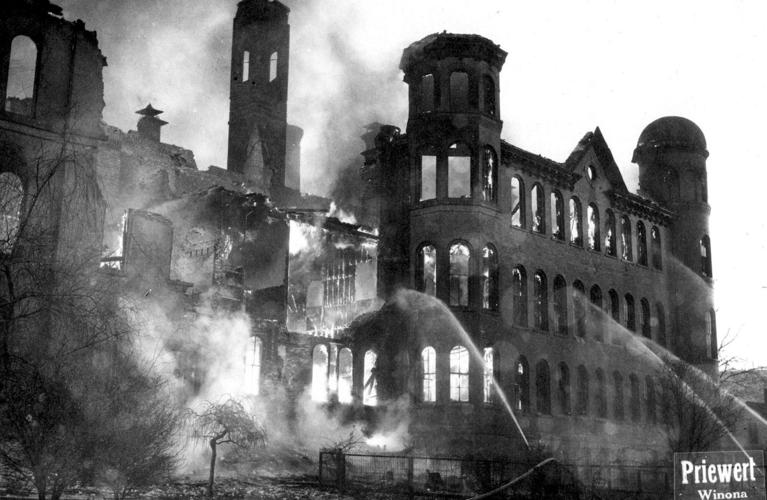
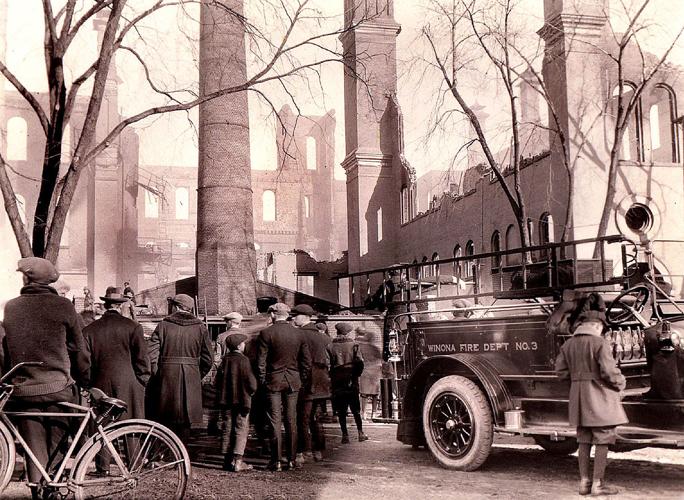
Winona Fire Chief W.C. Norton deployed all the forces at his disposal to fight the blaze. At one point, firefighters had 15 streams of water directed against the fire, ultimately dumping more than 800,000 gallons -- nearly a day's supply for the entire city -- into the conflagration.
But the battle was lost before it really began. The ferocious heat and dense smoke kept firefighters from ever entering the building to directly confront the flames. Early on, Norton's efforts were directed at keeping the fire from spreading to the adjoining library, model school and the residential neighborhood surrounding the college.
The roaring flames created violent updrafts that carried flaming embers high into the rning sky. A light breeze blowing out of the west caught the firebrands and carried them 10 to 12 blocks to the east -- one blazing book landed near Mankato Avenue -- dropping them on rooftops, threatening to set a large swath of the city ablaze.
Men and boys climbed onto frosty rooftops to fight the rain of fire with rakes, brooms, buckets and garden hoses. At one point, Norton detached half his force to contain the threat to the neighborhood.
As the main blaze began to subside, the extreme heat caused the timbers supporting the tile roof of the library to ignite. Immediate attention to the roof fire saved the building, though hundreds of books suffered water damage as a result.
At the end of the day, a blackened masonry shell was all that remained of College Hall. Deputy State Fire Marshal Bert Kingsley praised Norton and his men for a valiant, if doomed, effort. "If the same fire had confronted the Minneapolis fire department, the result would have been the same," Kingsley said.
The loss was devastating. Not only would the college have to function without its main classroom building, faculty members lost lecture notes, research and substantial personal libraries.
John Holzinger, nature study teacher and curator of the college's natural history museum, lost a lifetime's work in the fire. Since 1882, Holzinger had developed and catalogued the collection of flora, fauna and fossils. Surveying the destruction, he said, "Nothing is left at present of all the things which, for 36 years, helped us in nature study, except only the moon and the stars."
Only, and critically, the college records were preserved. Locked in a fireproof vault, they were retrieved intact from the cooling ashes.
College President Guy Maxwell's reaction was resolute. The winter term convocation was held as scheduled at 9 a.m. Monday in the First Congregational Church. As the tottering walls of the old building were toppled, classes relocated to churches and other public buildings and the State Teacher's College Board, led by Stephen Somsen, put the wheels in motion to fund a new building to go up on the site of the old. In the fall of 1924, the new college building -- later named Somsen Hall -- was open for classes.
Kingsley's investigation determined the fire got its start in the southeast corner in a space between the basement ceiling and the floor above. The spaces between floor and ceiling held several inches of dust that filtered between the years between the floorboards above and was saturated with the oil routinely used to refinish the wood flooring.
"With its inflammable material, open construction, large number of shafts of various kinds and wide attic, it was a veritable fire trap," Kingsley said of the old building.
The fire chief concluded that the explosions that tore through the building were caused by a buildup of smoke and gases that spread through the building as the fire progressed.
While arson was suspected, and was the cause favored by investigators, no evidence was ever discovered. Spontaneous combustion or an electrical malfunction also were advanced as the source of ignition, but ultimately no cause for the fire was ever determined.
"The city is lucky that the building is gone without a loss of life," Norton said. "The building was probably the worst firetrap in the city."


