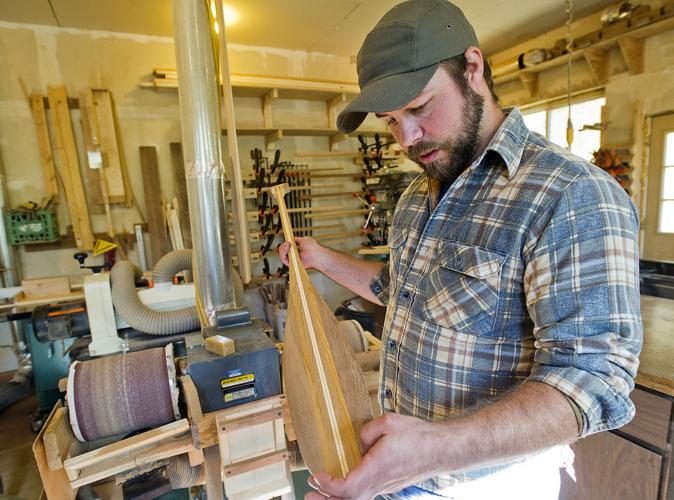
Todd Randall talks about how each canoe paddle is sanded before being finished at Sanborn Canoe Co. in Pickwick, Minn. The five-year-old company employs six people and is growing.
Andrew Link, Daily News
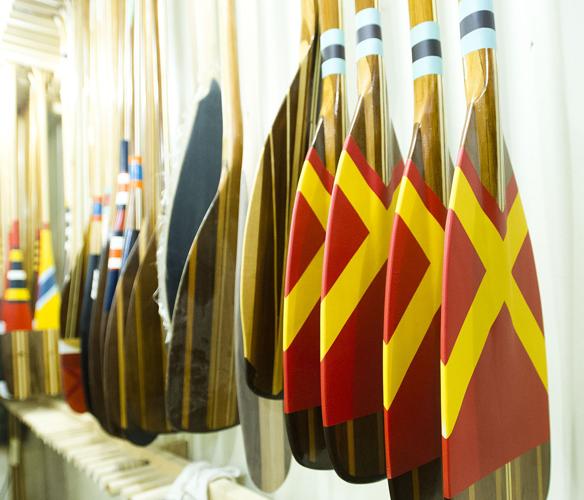
Paddles painted to resemble voyageur craftsmanship hang to dry at Sanborn Canoe Co. in Pickwick, Minn. While the labor of producing a paddle is minimal -- sometimes taking a half-hour or so -- the gluing, drying and finishing can take weeks.
Andrew Link, Daily News
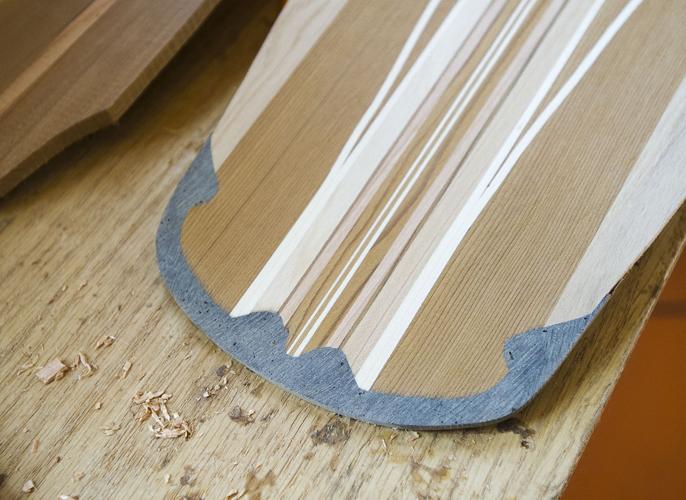
Sanborn Canoe's wilderness paddles include an epoxy tip to enhance durability for long-distance canoe trips.
It only takes about 25 minutes of labor to make a canoe paddle at Sanborn Canoe Company, but it can take up to three weeks between gluing the first strips together and painting the final colors.
Company co-owner Todd Randall said that’s how it goes at Sanborn.
“You hurry up, and then you wait,” he said.
Sanborn, a shop that ships paddles and canoe camping gear worldwide, began in 2009 as a basement enterprise when Randall and his cousin Zak Fellman decided to make a cedar-strip canoe like their grandfather had some 60 years before. They had so much fun working with the wood together that they were in business the following summer, making paddles for a quickly-growing base of customers.
Every paddle begins with cedar, a soft, light wood ideal for the repetitive paddling motion. Aspen, a more durable wood, is layered into performance-driven wilderness paddles.
Craftsmen at Sanborn cut the wood into narrow strips, which are glued together and then cut with a bandsaw into a rough paddle shape. Then the edges are planed and the surfaces smoothed with a drum sander. Once that’s done, the paddle is ready for layers of epoxy, fiberglass, varnish, and paint.
Paddle handgrips are left un-varnished and oiled instead, since an oiled grip is more comfortable for an all-day paddle.
The painted paddles feature simple designs that Fellman, who studied art in college, got from original voyageur designs. Voyageurs would paint paddles to finish them, and the patterns were also a personal statement with an added benefit of making them harder to steal.
“Each design does have a little story behind it,” Randall said. One is named “Minnetonka,” after the lake the cousins’ grandfather lived on.
Randall said he hopes Sanborn, which currently employs six people, will continue growing while producing quality products. They are building an addition to the workshop and hope to eventually make canoes for sale as well.
While some of their paddles invariably end up on cabin walls as art, Randall said he hopes they don’t stay there forever.
“We hope our paddles inspire other people to get out on the water,” he said.
ABOUT THIS SERIES
This story continues the third year of our Made in Winona series, an annual celebration of local companies large and small who manufacture all kinds of products. Read more stories and view content from previous years in a special section, at winonadailynews.com/special-section/madeinwinona.
Todd Randall talks about how each canoe paddle is sanded before being finished at Sanborn Canoe Co. in Pickwick, Minn. The five-year-old company employs six people and is growing.
Paddles painted to resemble voyageur craftsmanship hang to dry at Sanborn Canoe Co. in Pickwick, Minn. While the labor of producing a paddle is minimal -- sometimes taking a half-hour or so -- the gluing, drying and finishing can take weeks.