


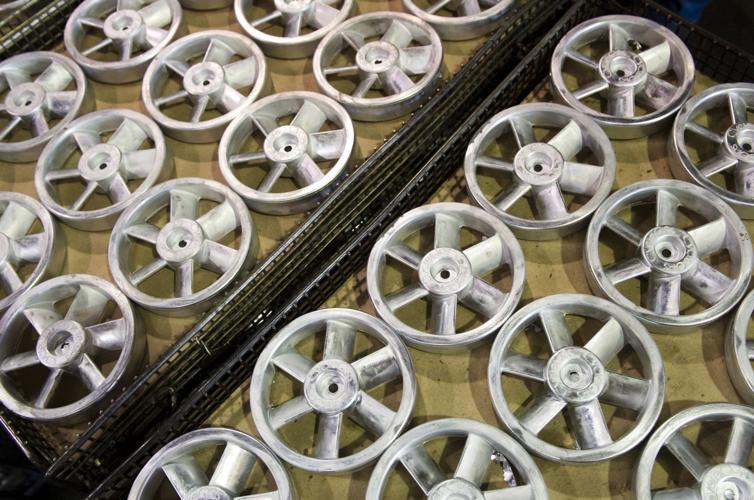
Grave markers, window cranks, plug covers, wheels for exercise bikes, license plates, and Harley-Davidson parts.
Items made at Winona’s Equality Die Cast couldn’t be more different, but the process in which they’re made is essentially the same.
It all starts with a more than 2,000-pound bundle of zinc separated into bars — they resemble a bar of gold — with each weighing about 20 pounds. The bars make their way across a dark-colored floor covered in silver shavings over to a furnace, where they’re plunged into a chrome-colored pool of liquid zinc.
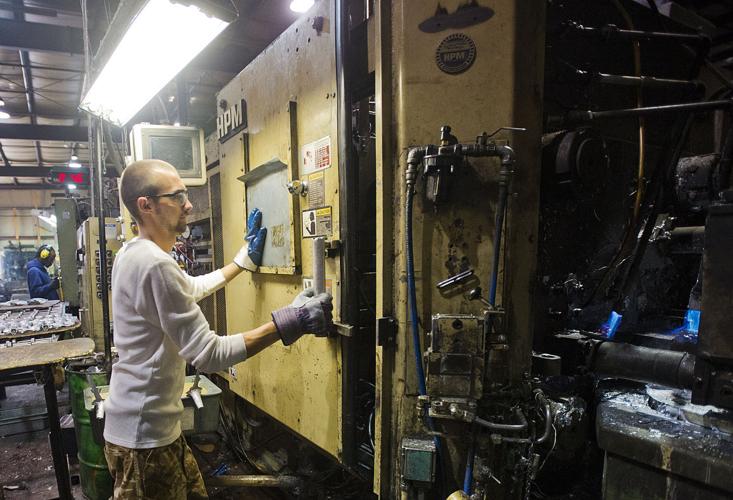
The zinc is pushed through open flame and into a machine that squeezes the material into a mold of whatever part is being made. Within 30 seconds or less the door to the machine is opened and the part is hard and ready to be pulled.
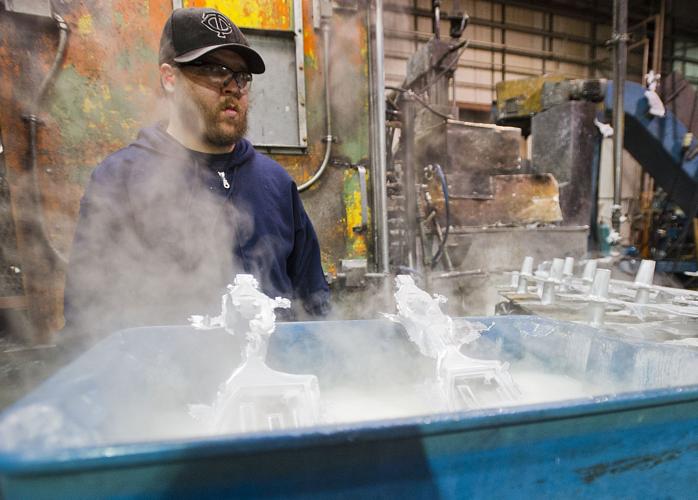
On a visit this week, employee Kevin Vanover stood in front of the door to the molding machine. With speed and precision, Vanover was in a routine. Open the door. Pull out the part. Stick it in water.
People are also reading…
Spray the machine with lubrication. Close the door. Grab the part from the water. Break off the excess. Stick the part on a table in a neat row. Repeat.
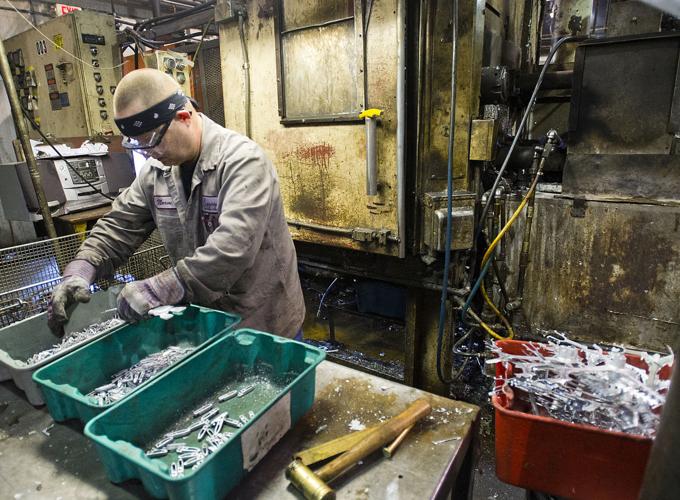
On the other side of the room, Norman Toulou was doing the same job, but with vastly different parts. The molded piece he took from the machine wasn’t just one part, but numerous small corner frames for a window and plug covers for semi tractors.
Toulou pulled the part from the machine. It sprayed itself with lubricant as the door shut. With the hunk of metal in his left hand, Toulou twisted his right hand over the part and broke off the separate little chunks, quickly separating them into different bins and throwing the scrap into another pile. Within seconds the cycle was done and the door opened again.
After the parts are molded, they’re taken to another machine where the excess is trimmed off by compressing down and cutting through the metal. To smooth the edges, some of the parts are tumbled in a big round bin before making their way to the finishing room.
Traveling through a set of doors, the parts are brought to a room full of drills, air spray hoses, and other equipment to make them ready for the shelf.
Then into a box and out into the world they go.
With about 50 employees – and room for more – the family-owned business has been making parts for various companies in Winona for more than two decades. Many of the parts they make are in demand seasonally, but overall, business has increased in recent years, spokesperson Tammy Foss said, with about six new companies asking for large amounts of parts in the last year.
First shift supervisor Roger Fegre said what makes the business special is the close-knit family feel.
“It’s a great company to work for,” Fegre said. “Everybody here, they care about the employees.”


