Time was when a bank’s building was expected to be as impressive as its balance sheet.
Merchants Bank had been taking care of depositors’ money in downtown Winona for 37 years when it opened its new bank building at the corner of Third and Center streets.
In 1974 the building was named to the National Register of Historic Places and is one of the anchor structures for Winona’s Downtown Historic District.
Designed by William Gray Purcell, George Feick, Jr., and George Grant Elmslie, the bank building is an outstanding example of the Prairie School of American architecture, its low lines and buff-colored brick facing reflecting the dominant landscape of the American heartland.
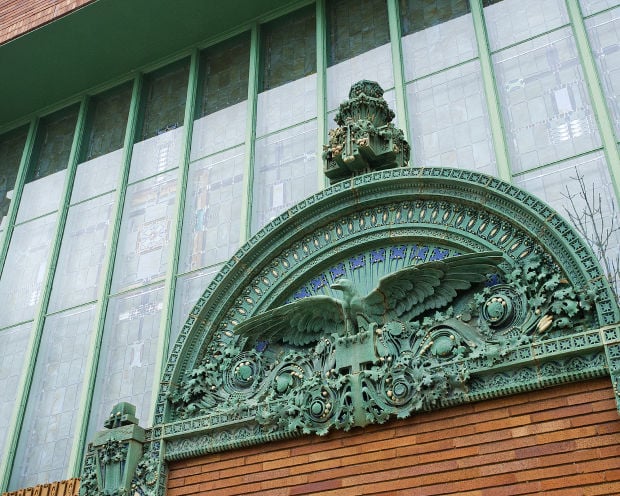
The design is deceptively simple, a lingering glance discovering the terra cotta eagle guarding the main entrance, and stepping inside revealing the terra cotta sheaves of grain accenting painted scenes of farm life, lit with the warm multi-hued sunlight filtering through stained glass windows and overhead skylights.
Merchants’ business proved successful as its building, and it is now a significant financial presence in the region, with branches in communities across the region.
Time was when a bank’s building was expected to be as impressive as its balance sheet.
Merchants Bank had been taking care of depositors’ money in downtown Winona for 37 years when it opened its new bank building at the corner of Third and Center streets.
In 1974 the building was named to the National Register of Historic Places and is one of the anchor structures for Winona’s Downtown Historic District.
Designed by William Gray Purcell, George Feick, Jr., and George Grant Elmslie, the bank building is an outstanding example of the Prairie School of American architecture, its low lines and buff-colored brick facing reflecting the dominant landscape of the American heartland.
The design is deceptively simple, a lingering glance discovering the terra cotta eagle guarding the main entrance, and stepping inside revealing the terra cotta sheaves of grain accenting painted scenes of farm life, lit with the warm multi-hued sunlight filtering through stained glass windows and overhead skylights.
Merchants’ business proved successful as its building, and it is now a significant financial presence in the region, with branches in communities across the region.
On Throwback Thursday we are bringing back collections of Winona history. We've collected some of the things and images that we think say Winona.
Time was when a bank’s building was expected to be as impressive as its balance sheet.
Merchants Bank had been taking care of depositors’ money in downtown Winona for 37 years when it opened its new bank building at the corner of Third and Center streets.
In 1974 the building was named to the National Register of Historic Places and is one of the anchor structures for Winona’s Downtown Historic District.
Designed by William Gray Purcell, George Feick, Jr., and George Grant Elmslie, the bank building is an outstanding example of the Prairie School of American architecture, its low lines and buff-colored brick facing reflecting the dominant landscape of the American heartland.
The design is deceptively simple, a lingering glance discovering the terra cotta eagle guarding the main entrance, and stepping inside revealing the terra cotta sheaves of grain accenting painted scenes of farm life, lit with the warm multi-hued sunlight filtering through stained glass windows and overhead skylights.
Merchants’ business proved successful as its building, and it is now a significant financial presence in the region, with branches in communities across the region.