It’s a bridge that carries less traffic than memories.
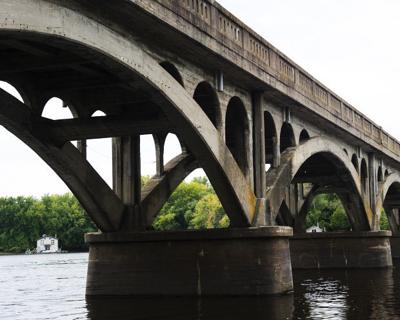
For nearly a century the old concrete arch has spanned the north channel of the Mississippi from Latsch Island to Aghaming Park and Wisconsin beyond with steadfast grace, surviving storms, high water and benign neglect.
Built in 1917 to replace the deteriorated wooden approach to the steel high wagon bridge that rose above the river’s main channel, at a height to give clearance to the tall-stacked steamboats that plied the Mississippi at its opening in 1892, the reinforced concrete bridge stretches 1,229 feet shore-to-shore. Its deck stands 32 feet above the water, the foot-thick concrete railing another four feet above that – high enough to challenge and thrill generations of young Winonans for whom a plunge off the Old Wagon Bridge is a well-remembered, and oft repeated, rite of passage.
Handed over to the city of Winona in 1942 when the new interstate bridge was opened and the old High Wagon Bridge torn down for war scrap, tearing down the old concrete span was judged more trouble and expense than it was worth. Fifty years later it had deteriorated to the point where it had to be closed, but tearing it down was too expensive and the memories it carried too precious to allow demolition. A citizen-led effort resulted in its refurbishing and reopening in 2004.
It’s a bridge that carries less traffic than memories.
For nearly a century the old concrete arch has spanned the north channel of the Mississippi from Latsch Island to Aghaming Park and Wisconsin beyond with steadfast grace, surviving storms, high water and benign neglect.
Built in 1917 to replace the deteriorated wooden approach to the steel high wagon bridge that rose above the river’s main channel, at a height to give clearance to the tall-stacked steamboats that plied the Mississippi at its opening in 1892, the reinforced concrete bridge stretches 1,229 feet shore-to-shore. Its deck stands 32 feet above the water, the foot-thick concrete railing another four feet above that – high enough to challenge and thrill generations of young Winonans for whom a plunge off the Old Wagon Bridge is a well-remembered, and oft repeated, rite of passage.
Handed over to the city of Winona in 1942 when the new interstate bridge was opened and the old High Wagon Bridge torn down for war scrap, tearing down the old concrete span was judged more trouble and expense than it was worth. Fifty years later it had deteriorated to the point where it had to be closed, but tearing it down was too expensive and the memories it carried too precious to allow demolition. A citizen-led effort resulted in its refurbishing and reopening in 2004.
On Throwback Thursday we are bringing back collections of Winona history. We've collected some of the things and images that we think say Winona.
It’s a bridge that carries less traffic than memories.
For nearly a century the old concrete arch has spanned the north channel of the Mississippi from Latsch Island to Aghaming Park and Wisconsin beyond with steadfast grace, surviving storms, high water and benign neglect.
Built in 1917 to replace the deteriorated wooden approach to the steel high wagon bridge that rose above the river’s main channel, at a height to give clearance to the tall-stacked steamboats that plied the Mississippi at its opening in 1892, the reinforced concrete bridge stretches 1,229 feet shore-to-shore. Its deck stands 32 feet above the water, the foot-thick concrete railing another four feet above that – high enough to challenge and thrill generations of young Winonans for whom a plunge off the Old Wagon Bridge is a well-remembered, and oft repeated, rite of passage.
Handed over to the city of Winona in 1942 when the new interstate bridge was opened and the old High Wagon Bridge torn down for war scrap, tearing down the old concrete span was judged more trouble and expense than it was worth. Fifty years later it had deteriorated to the point where it had to be closed, but tearing it down was too expensive and the memories it carried too precious to allow demolition. A citizen-led effort resulted in its refurbishing and reopening in 2004.